While formatted somewhat like my Orthodoxies post, these are significantly more difficult concerns that I’ve run into recently. Several people on Discord were kind enough to ask that I write up my difficulties, so that they might take a stab at a solution. So here goes nothing.
First, three assumptions you’ll need to understand, going in:
- To me, a campfire encounter is the sort of monster that functions really well in a story told around a campfire, but that seems to become either boring in a D&D fantasy adventure context, or it becomes a mystery that’s very unintuitive to solve for most players.
- For various reasons, I do in fact want these “campfire encounter” monsters to occur as single encounters in a dungeon or dungeon-like environment. I think the most accessible solution for a “campfire encounter” is just to build an entire campaign around a monster. For instance, if you have a hard time conveying how scary the ghost of a haunted house is as a single encounter, perhaps you can tool the entire haunted house into emphasizing how scary this one particular ghost is…this is effective, but is not a solution that’s viable for my project (feel free to ask me on Discord about why this is, but for this exercise, consider this a restriction).
- A lot of these problems are almost trivially fixed by being more responsive to how players behave, and addressing their behaviors in the game, either with improvised roleplaying changes, or by pausing the game to clear up a misunderstanding. However, these are module-writing woes, not GMing woes – I’m trying to figure out how to achieve results consistently as a module-writer. So, GM advice like “just make this monster less scary until your players are willing to talk to it”, for example, isn’t helpful to my particular conundrum.
Okay, let’s begin.
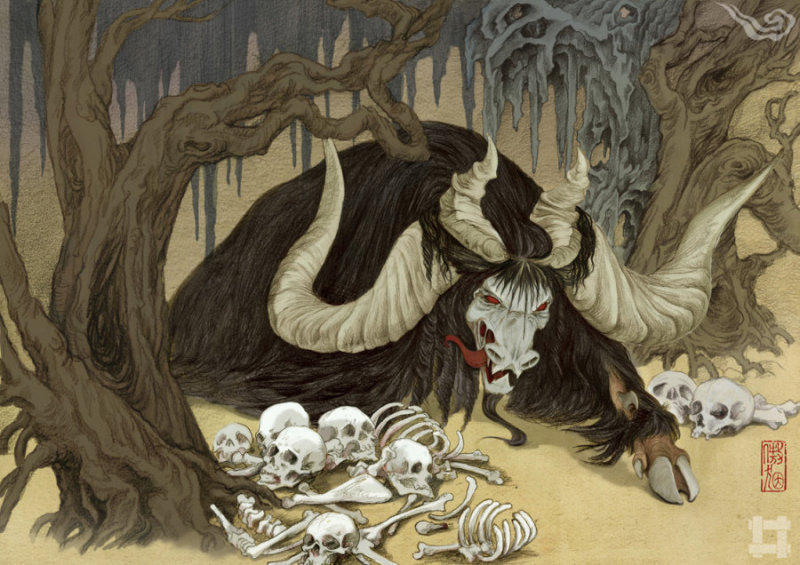
- Given a mythological monster whose signature ability in stories is to fight for seven days and seven nights without tiring, I decided to make a monster that had a fast fleeing speed, as well as the ability to mitigate a lot of the negative effects of retreating in D&D.
The intention was to have this monster be a recurring threat, but in actual play, the monster proved to be exasperating for players, who felt that it was something they weren’t being allowed to defeat. How could such a myth be converted into an encounter that would still pay respects to the myth, yet without being irritating in play? There are many other similar demons who must be killed three times to truly die, or who must be defeated three times to truly submit, et cetera, that are similarly hard to implement. Especially as, for a lot of these creatures, this facet of their existence is the most standout part (they otherwise are interchangeable with just…well-armed bandits, or slightly more aggressive tigers, or whatever). - Given a mythological monster who was only defeated in its story by heroes supplicating the gods into coming down to earth and striking the monster down for them, how could you incorporate this monster into a dungeon encounter? In the original story, the monster was essentially a runaway from Heaven, and Heaven had no leads as to where the monster went. The protagonists, realizing that they could not slay the monster, but also realizing that it was a runaway from heaven, essentially reported the monster to the authorities, who came to take him away.
I have the feeling this would not be satisfactory in a D&D encounter…particularly not a written module. More than perhaps any other encounter type, this sort of monster feels like it would only work with an entire campaign built around it…which is not what I want. - I’ve been trying to figure out what sort of layout works best for a “stealth dungeon”, and this is one of the maps that I tried out:

The way I ran the dungeon, two invincible liches start at room 16, and spread out to try and corner the players as they navigate the space. Players need to get to room 26 and then escape.
I ran into a lot of issues when running this, not merely issues with the dungeon layout, but one of those issues was that I didn’t know how to proceduralize the enemy movement in a “stealth” dungeon. If I just run the liches as intelligent beings with a sense of the tomb, they could just wait for players in chamber 1, since the players need to eventually leave from there. But this somewhat negates the point of a stealth mission – if you’re going to run into enemies anyway, you may as well do it on your terms, not theirs.
Another issue was the lack of feedback – in a lot of stealth games, you usually have some sense of where the enemies are to help you decide where to hide and how to route your infiltration. I tried having the liches converse with one another, and in a separate playtest gave players a one-way ability to see through walls, but it just felt clunky and uninspired – plus the more “stuff” I overlaid on top of the dungeon, the more the feeling of dread from actually exploring the tomb vanished.
So…with all that as context for what I tried, the encounter is this: some number of invincible undead are in a tomb, and encountering them is lethal, but they guard something you need. How do you make that work in a D&D game, in module format?
4. There’s a monster that I see in a lot of horror games and see in a lot of other media as well – it’s the monster that only is able to move when you aren’t looking at it. You know the type – Weeping Angels from Doctor Who, haunted dolls from Emily Wants to Play, SCP-173, etc. While I can think of some ways of building an entire campaign around this concept, I’m a bit stuck on how to “dumb down” such a monster for the purposes of a wandering monster table – how do you introduce this weird monster mechanic in a campaign where there’s already a lot of other stuff going on, and how do you have it as a constant threat (like how a wolf or bandit would be on a wandering monster table), without it overtaking the entire campaign?
5. Finally, I’ve got a set of “monsters” which aren’t really monsters – they’re more set-dressing. Birds whose feathers store various magicks and thus can be used in various potent ingredients, horned rabbits (think jackalopes) whose horns can be used in potions, and flying snakes who are attracted to gold and who will fly great distances so that they can sleep on piles of gold. What’s the best implementation of “magical folkloric wildlife” like the above? Do I create a side-quest structure? Do I cut them out for being too distracting? Do I make them into more meaningful encounters (the birds could become something like blood hawks, the rabbits could become giant rabbits that attack you, the treasure snakes could be very venomous)?
My instincts say that making things “threats” when they’re not supposed to be sort of invalidates the role they have from their folklore…but D&D, especially in the dungeon context I’m working in, is so threat/reward-focused that I get caught in a loop of thinking of everything in that same context.


Leave a Reply