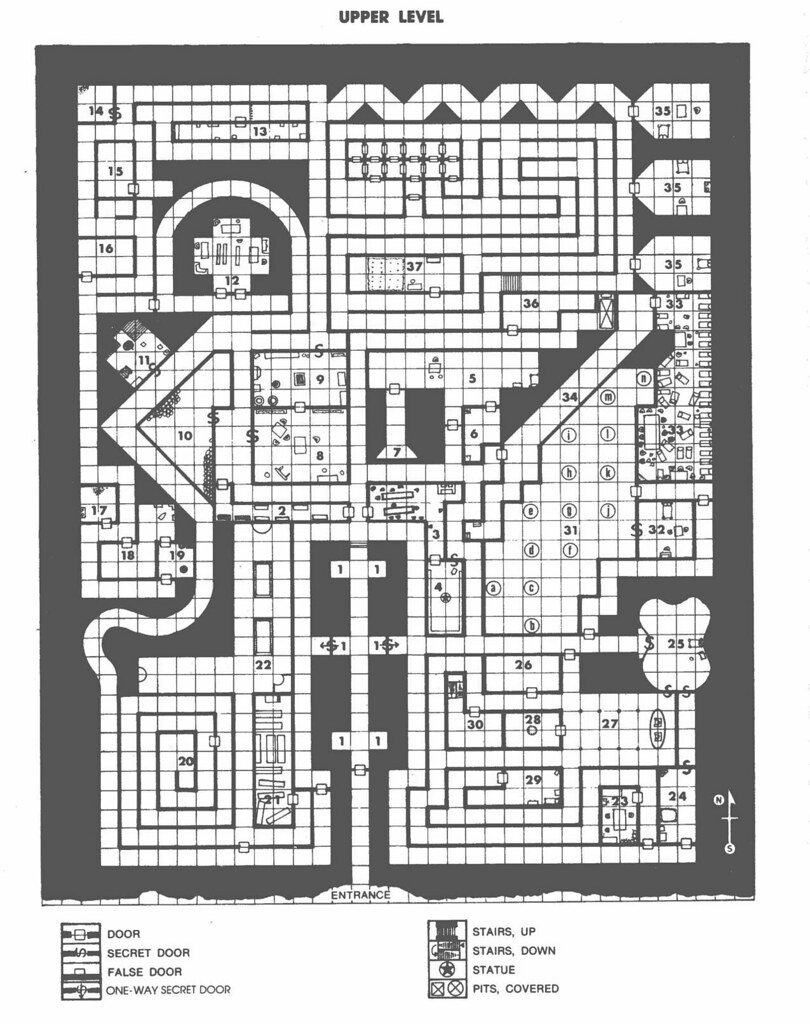
The dungeon is an imagined space of complex, interconnected networks that emerged in fantasy tabletop role-playing games in the 1970s. As a space distinctive to early TTRPGs, much of the dungeon’s evolution as an object of design happened organically – as did the practice of playing the dungeon.
How then, are we to understand this space?
Contemporary definitions of the dungeon are romantic! Evocative! …And misleading.
From the D&D 5th Edition 2014 Dungeon Master’s Guide, in the Adventure Environments Chapter:
Some dungeons are old strongholds abandoned by the folk who built them. Others are natural caves or weird lairs carved out by foul monsters. They attract evil cults, monster tribes, and reclusive creatures. Dungeons are also home to ancient treasures, …often guarded by traps or jealously kept by the monsters that have collected them.
And later on,
A dungeon reflects its creators.
…
Details bring a dungeon setting’s personality to life.
…
Except in the case of a natural cavern, a dungeon is crafted and inhabited for a specific purpose that influences its design and features.
We can understand the tenor of these explanations as a loss of criticality, as marketing enthusiasm to a de-energized audience, or offer other such explanations. For our purposes, note that while this gives a Game Master reason to consider the dungeon’s backstory (indeed, the crux of today’s D&D dungeon-building advice, much like its characterization advice, seems to be backstory), it offers little in the way of structure. “A dungeon reflects its creators” sounds wise, but it’s a truism that applies equally to any kitchen. What makes a dungeon different from any other internal space? What features should every dungeon have? If dungeons are part of adventure design, what distinguishes a competently made dungeon from an incompetently made one?
D&D 5th Edition 2024 Dungeon Master’s Guide relegates Dungeons to a tool in the Game Master’s Toolbox. You find no explanation of Dungeons as they relate to either Creating Adventures (Chapter 4) or Creating Campaigns (Chapter 5). They are only part of the Toolbox chapter, where we are told,
Many D&D adventures revolve dungeons – interior spaces such as great halls and tombs, subterranean monster lairs, mazes riddled with traps, natural caverns extending for miles beneath the surface, and ruined castles…of course, not every adventure takes place in a dungeon.
Revolve dungeons, they say. I’m genuinely uncertain if the custodians of our hobby cannot be bothered to write a single new sentence about its namesake that survives a proofreading, and this should say “involve dungeons”, or if this is a Freudian slip. Perhaps we are meant to picture adventures orbiting a dungeon entrance like satellites, or spiraling ever inward towards it, but never descending.
Cattiness aside, I admit that the 2014 and 2024 DMGs aren’t truly in tension. The trajectory may be distressing but both treat the dungeon as a container that happens to have content for us. They cannot quite comprehend the dungeon as a structure that, in and of itself, generates play. There is an argument to be made that the 2024 book is more honest – it stops pretending that the garb which we outfit our adventure plot in is what matters.
I’m of the camp that the dungeon and its structure matters quite a bit, which forces us to look elsewhere.
A second caveat here: two contemporary quote snippets does not a survey make. The examples above make concrete the contrast between contemporary D&D dungeon talk and OSR D&D dungeon talk. If the reader wishes more charity granted to modern discourse, I yield the proof that it is deserved as an exercise to them.
The intention of this post is to define terms used when speaking about dungeons in the Old School Revival – the OSR. More than any movement, the OSR has produced the most vocabulary that allow us to dissect the dungeon into its constituent pieces, nomenclature based on gaming utility rather than the in-fiction lore, and language for the practice of playing them. I find it fruitful ground, and it has clarified for me why the hobby has been so enamored with this “Get in the Hole” ethos. I also find it frustrating that all these terms are scattered across the internet, so partly this is a compilation post as well!
OSR definitions, as a focus, are not without flaws. First, they assume certain priors which the modern player may struggle to imagine, such as race-as-class, high lethality, and all the normal hurdles one encounters when trying to figure out the OSR as an outsider. Second, OSR best practices for dungeon design are not always compatible with modern dungeoneering play – this will be evident by the end of this post, but as it is long, I want to reassure the reader that if they come across advice that doesn’t apply to their games, there is good reason for that.
Now, we’re quite discombobulated and eager to begin, I imagine, so: what is a dungeon?
Henri Lefebvre, a French philosopher and sociologist of the Marxist tradition, offers a way to understand dungeons through his work on cities and urban theory. In particular, Lefebvre comments that a space can be examined as a representation of space, a spatial practice, and a lived space. Finally, we have a means of breaking down a dungeon to its constituent parts, and in doing so a way of ascertaining whether those parts are functional or dysfunctional, depending on how we as designers construct them.
The Dungeon
noun:
an imagined space satisfying three criteria. It comes into being as (1) a representation of space as conceived by the designer, made of text and diagram by a Game Master who acts as the architect of the dungeon. It must then be encountered by players as (2) spatial practice – a space they perceive, coherently, through their fictional senses as described by the Game Master and which they are tasked with traversing. Finally, it must be a (3) lived space – a space which has its own rules and norms, as does any lived space, by interrogating the spatial norms and relations kept alive and known within the community.
For a good Dungeon, I append four other qualifications to the definition: an imagined space with (4) a minimum of 16 rooms, ideally 22 or more, (5) a Jaquaysed layout, (6) design with Doors & Basins in mind, and (7) evocation of the Mythic Underworld.
Engaging with this requires clarification and further definitions.
(1) The representation criterion is difficult to fail, so it matters only insofar as the fact that a blank dungeon is not conceived by the designer. We should not credit a dungeon with nothing in it, nor credit it for elements we add ourselves. Some grace for the expectations within the OSR play tradition, some grace for the designer respecting our competency, yes. But if we spice up a bland space, the spice was not conceived by the designer, and the designer cannot be credited for the same.
(2) One of the big problems with modern practice is that dungeon maps are dropped unceremoniously onto the board, fully revealed or soon-to-be fully revealed. This does not give the sensation of exploring a space. It grants the sensation of seeing one from above, spotting chairs and tables before the GM can narrate them into being, asking “what is that?”, as a bird might, if it saw such features as a higher being and desired to talk out of turn. No. A true dungeon must be mapped, interrogated, never freely shown. That is the experience of traversal in make-believe. Drop a map onto the table and you may as well drop bowling ball through the delicate act of traversing, replace it with map-reading, with gleeful interruption. Before the GM can grant you eyes and ears to experience a space, you are already flaunting your strange foreknowledge in defiance, and in so doing the dungeon ceases to be a dungeon.
(3) In the old school, there are expectations for what it means to listen at a door and hear nothing: nothing is there, you failed your Hear Noises roll, or there are undead. Those are the options, hanging off ironclad rules. There are expectations when you come upon a pool of glowing water. Do you risk a drink, dip something in to test it, or ignore it, knowing the drink can grant you great power but that it is a dangerous gamble? If a door slams shut behind you, it is because the dungeon hates you, and wants you to die, and you must be brave and cope with this. The community knows this is the way of the dungeon, and so player skill and experience let vetrans inhabit this imaginary dungeon more comfortably than newcomers, twitching idly, can. This gap of experience, the ability to comprehend your existence inside both a roleplaying framework and a gaming one, lessens significantly in modern play. It is vanished everywhere except in combat, the only remaining game loop. Dungeons are not much different from being outdoors, or in a house, and so the lived experience does not truly have its own rules and norms, but the same rules and norms as the outdoors, or a house.
Ideally 22 or More Rooms
A qualification from my own playtesting. I recommend a minimum of 16 rooms, ideally 22+, for a dungeon meant to reinforce the Town & Dungeon loop.
Across different groups and ages, ranging from children to people who grew up with OD&D, an interesting pattern holds: players don’t seriously consider backtracking until about room 8. Barring catastrophe (half the party crushed by a boulder trap in the very first room), they’ll begin floating the idea of retreat around this point, and it often takes one or two more rooms before more stubborn players acquiesce. So retreat functionally starts around rooms 9-10. With that metric in mind, smaller room counts create problems:
- 1-10 rooms can create a lack of intentionality. Players may finish the dungeon in one go without ever discussing retreat. There’s nothing wrong inherently with one-cycling a dungeon – to borrow speedrunner parlance – but for the loop to be reinforced, that should be a meaningful intention. A party should be pushing on past their limits to try for the speedrunner approach. If the thought of backtracking doesn’t even come up, the dungeon was too short for the idea of pushing past their limits to arise. (This stacks with the Wandering Monsters issue I discuss, also about this room-count, in “Location-Based Adventures”.)
- At 10-16 Rooms, you hit what I call an “unhappy medium”. Players who backtrack feel they could have done it all in one go – that retreat was wasted time rather than prudence. Especially true because, say, a 14-room dungeon doesn’t require all 14 rooms to be explored to be completed: a given group may feel they’ve cleared it on their 12th room, leave 2 unexplored, and feel very annoyed they hadn’t pushed that one room further from 11, where they chose to backtrack. After enough experience, this bitter feeling resolves into one of two conclusions. Most modern players conclude they prefer location-based adventures outright; OSR players tend to conclude they prefer dungeons with a higher room-count.
- At 16-21 rooms, you hit a second, lesser “unhappy medium”. If the 11-16 band is where players feel bitter for backtracking the first time, here players feel bitter about their decision to backtrack for the second time. Again, it can lead to a sense that more boldness would have wrapped everything up in two runs. This comes up less consistently, and when it does come up is less intense of a negative emotion. My general takeaway: the more times players feel they were “supposed to” retreat, the more normal retreating feels, and the less insecurity or sense of failure they attach to backtracking “too much”.
Hence, the 22-or-more recommendation on my part, though you avoid the worst hump with a minimum of 16 rooms.
Town & Dungeon
Town & Dungeon play is a basic D&D play loop: the party descends into a dungeon, returns to town to rest and resupply, and repeats until the dungeon is plundered to their content. The town is a safe, largely undescribed home base; the dungeon is where all meaningful play happens. No wilderness layer sits between them.
My above 16+ rooms requirement derives from this loop. At lower room-counts, players simply finish the dungeon in a single delve, and the loop becomes moot.
The term “Town & Dungeon” is my own creation, best understood as a minimalist test harness: a testing environment used to verify whether a set of rules and an adventure text can run the game’s most basic loop.
Town & Dungeon play is not a distinct historical era. Wilderness rules existed even in Original Dungeons & Dragons, albeit only by reference to The Outdoor Survival board game.
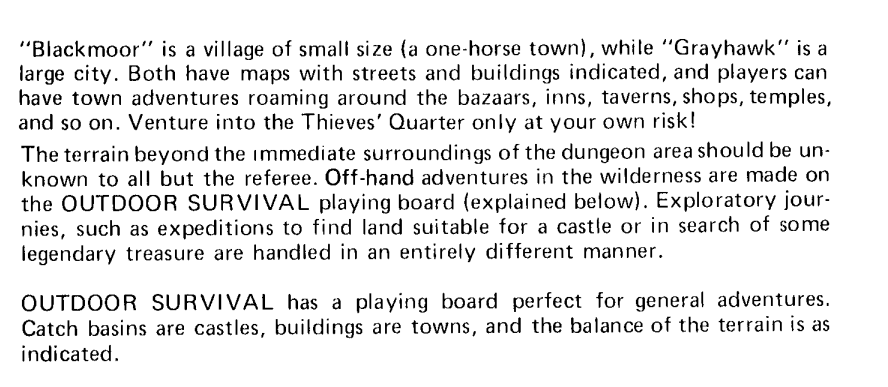
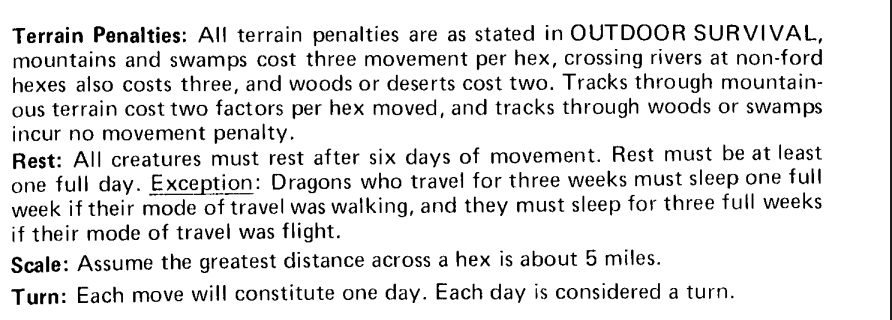
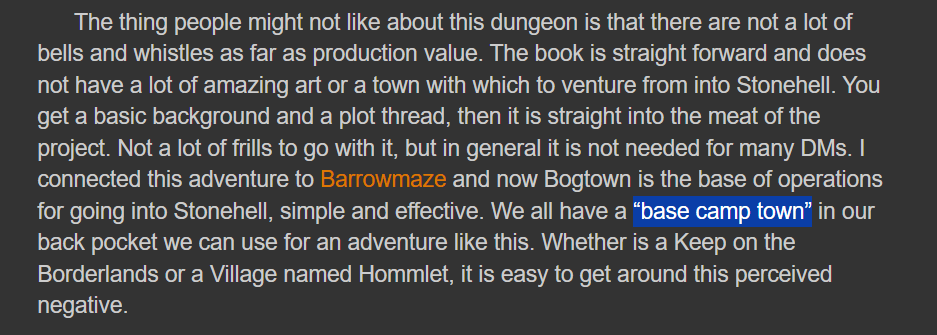
But there is textual evidence that the wilderness layer was often handwaved away. In OD&D discussions, players didn’t always own The Outdoor Survival board game. In Basic D&D, wilderness rules only “activated” at level 3, with the Expert Set. While not an era or tradition of play, Town & Dungeon is a persistent mode that players sprung back to whenever the wilderness layer was skipped, ignored, or hard to access. The snippet below exists in pretty good company.

Since the term, by my own admittance, is one I’ve coined, how can we spot the style in the wild – in old forum posts or overheard conversation?
By these fingerprints:
- Talk of a “base camp” or “home base” town.
- For OD&D, claims that a group had little use for the third Little Brown Book (Underworld & Wilderness Adventures).
- For B/X D&D, claims of mostly using Basic, not Expert.
- West Marches campaigns. These definitively have a wilderness layer, but the etiquette of being back in town by each session’s end means that the wilderness is often truncated or eliminated. In practice, a lot of West Marches best practices are identical to Town & Dungeon best practices.
Town & Dungeon play is the minimum basic function a dungeon must fulfill. Strip away the wilderness, urban intrigue, and epic plot, and the core question is left: does this dungeon, plus a place to resupply, produce a working game? It removes every distraction and focuses the mind on what the machinery actually needs to do.
Jaquaysing (Xandering)
Techniques to de-linearize a dungeon layout, named after Jennell Jaquays’ dungeon design work for Judges Guild. Not all techniques need be applied, but they include:
- Multiple entrances
- Loops instead of branching paths
- Multiple connections between levels
- Discontinuous connections between levels
- Secret paths
- Sub-levels for multi-level dungeons
- Divided levels for multi-level dungeons
- Nested dungeons
- Minor elevation shifts
- Having PCs enter at the dungeon’s midpoint
- Non-Euclidean geoemetry
- Extradimensional spaces
Justin Alexander expounds on the techniques in detail, HERE, and – importantly for recognizing Jennell Jaquays’s contribution as an original example of their execution, on the naming schema, HERE. The core idea behind having less linearity in a dungeon is that pathfinding should be a meaningful endeavor. To reach a specific room in a dungeon, a party that has more thoroughly explored the space should be rewarded by now having harder and easier options to route there, not merely with a larger tally of dead ends. Jaquaysing applies beyond dungeons too. Add a second entrance to an interior space, even a small battle-map, and you begin to create pathfinding questions: which side do we enter from?
Doors & Pools:
A dungeon design ethos of added rules granularity paid to doors and pools.
Doors are first mentioned in Original D&D and encompass stuck doors, lockpicking, doors that close behind you, doors that open freely to monsters but stick for players, doors requiring multiple people to open, secret doors, doors and levers, and semi-hidden doors.
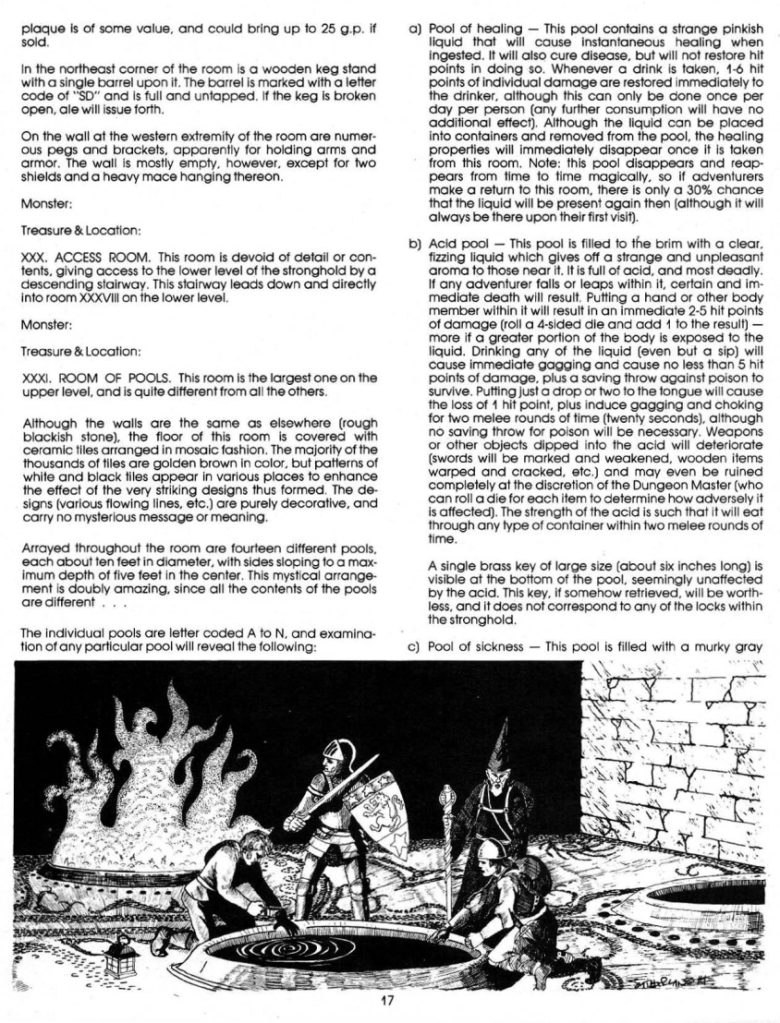
Pools are a tradition more often kept in roguelikes than in D&D, though they appear early. B1: In Search of the Unknown by Mike Carr features a “Room of Pools” with fourteen varieties – acid, healing, wine, green slime, and many other sorts of enchanted pool.
By giving players a set way of interacting with these default dungeon features – do we try breaking down the door or picking the lock, do we spike a door open or shut, do we drink from this pool or not – Doors & Pools strengthen the sense of the dungeon as a lived space in the Lefebvrian sense: the space has rules and norms in how one interacts with it, which a community of experienced players will be more familiar with than newcomers. A longer post specifically glazing the worth of Doors & Pools in the OSR is forthcoming, mostly because not enough OSR systems actually care about Doors & Pools (!), but suffice to say: the best adventure modules attend to these details with care.
Mythic Underworld
A dungeon that obeys its own laws – weird, otherworldly, and apart from the natural order. The term comes to us from Jason Cone’s Philotomy’s Musings (2007), which I’ll quote directly:
There is a school of thought on dungeons that says they should have been built with a distinct purpose, should “make sense” as far as the inhabitants and their ecology, and shouldn’t necessarily be the centerpiece of the game (after all, the Mines of Moria were just a place to get through). None of that need be true for a megadungeon underworld. There might be a reason the dungeon exists, but there might not; it might simply be. It certainly can, and perhaps should, be the centerpiece of the game. As for ecology, a megadungeon should have a certain amount of verisimilitude and internal consistency, but it is an underworld: a place where normal laws of reality may not apply, and may be bent, warped, or broken. Not merely an underground site or a lair, not sane, the underworld gnaws on the physical world like some chaotic cancer…
…For example, consider the OD&D approach to doors and to vision in the underworld: Generally, doors will not open by turning the handle or by a push. Doors must be forced open by strength…Most doors will automatically close, despite the difficulty in opening them. Doors will automatically open for monsters, unless they are held shut against them by characters. Doors can be wedged open by means of spikes, but there is a one-third chance (die 5-6) that the spike will slip and the door will shut…
…Notice that all characters, including those which can see in normal darkness (e.g. elves, dwarves) require a light source in the underworld, while all denizens of the place possess infravision or the ability to see in total darkness. Even more telling, a monster that enters in the service of a character loses this special vision. Similarly, characters must force their way through doors and have difficulty keeping them open; however, these same doors automatically open for monsters. This is a clear example of how normal rules do not apply to the underworld, and how the underworld, itself, works against the characters exploring it.
Of course, none of this demands that every dungeon need be a mythic underworld…nevertheless, the central dungeon of the campaign benefits from the strange other-worldliness that characterizes a mythic underworld.
A mythic underworld is not the “Underdark” – that’s an underground wilderness of caves, tunnel, and cities, which is its own distinct concept.
Cone wrote his essays in response to Original D&D (1974), not Basic D&D (1977-onward), and scoped his claim narrowly. Original context aside, Philotomy’s Musings is arguably a bigger cornerstone of the OSR than Basic D&D itself, so it necessitates a place in my definition of a dungeon. Every reader will use it differently, and that’s okay. My own preference is to start dungeons with some identifiable surface structure and let it give way to the mythic below: a peasant’s cruck hut gives way to a troglodyte cavern in its basement, an archaeological dig site breaks into a buried lost city, a lighthouse reveals itself to be the tip of a submerged ifrit citadel. The surface is where players’ assumptions still work – they know a cruck hut is residential, what a dig site looks like, expect a lighthouse to have an oil storage room and a lantern atop a tower. Below, these intuitions are stripped away, and they must learn each dungeon on its own terms. To that end, I often hold off on doors slamming shut behind the party until they reach my dungeons’ second layer.
Whew! With our initial definitions out of the way, it’s time to look at some
DUNGEON TAXONOMAYYYYYYYY
Every dungeon is a different beast...
Monster Hotel/Motel/Zoo
Definition:
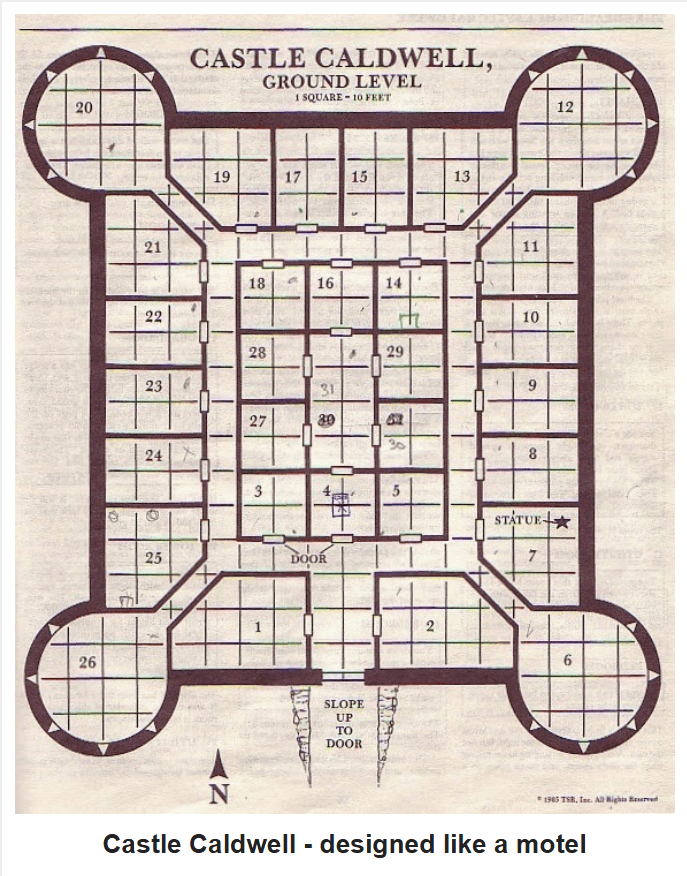
A monster hotel is a dungeon where monsters sit in their own rooms, waiting to be discovered. A rich mixture of foes lives down the hall from one another in relative peace and ignorance of each other. They don’t investigate loud noises, spend their carefully guarded treasure, or participate in a community in any meaningful sense.
Origin:
While this type of dungeon has existed since the dawn of the hobby, the term was coined circa 2011 by Tim Kask in an interview, where he described early D&D adventure design as a “massacre at the zoo”. By 2014, this term had broadened to colloquial usage of monster zoo, monster hotel, and monster motel.
Trope Codifiers:
- Palace of the Vampire Queen
- B9: Castle Caldwell & Beyond
Design Logic:
Monster hotels are written to support a hack-and-slash playstyle. Players are expected to kill or bypass monsters, take their treasure, and move on. Insofar as one monster hotel is better or worse than another, it’s usually on the singular metric of how many unique monsters one can encounter before finishing the dungeon. The hotel-like form is easy to map, and any Monster Manual supplies what you need without further reading on dungeon design: look up a monster’s expected treasure, plop it in a room, have it guard the treasure, rinse and repeat. Cover the rooms with doors so the Hear Noises rules can come into play. The result is an explorable space that exercises the major rules, showcases player competency, and pays out enough treasure for progression. A lot of kids who started playing D&D in childhood have dungeons that follow this ethos.
Contemporary Use:
Monster hotels, needless to say, have little depth. Few dungeons are made with this ethos as a goal. Much of the more nuanced discussion about the term is lost with the death of Google+, so the term now mostly appears in reviews – often as a pejorative, describing a dungeon with little thought behind it.
Gygaxian Naturalism
Definition:
A bounded tendency to describe monsters via game mechanics or in-world “social rules” that ground those monsters in the campaign world. This practice is primarily found in Gary Gygax’s editions of Dungeons & Dragons – OD&D and AD&D, but not B/X. Gygax himself expresses it as:
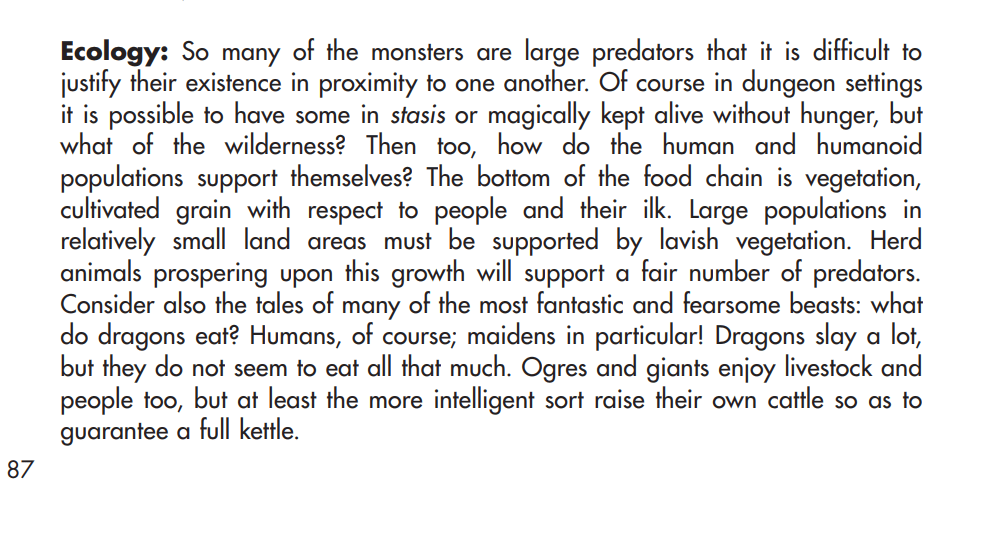
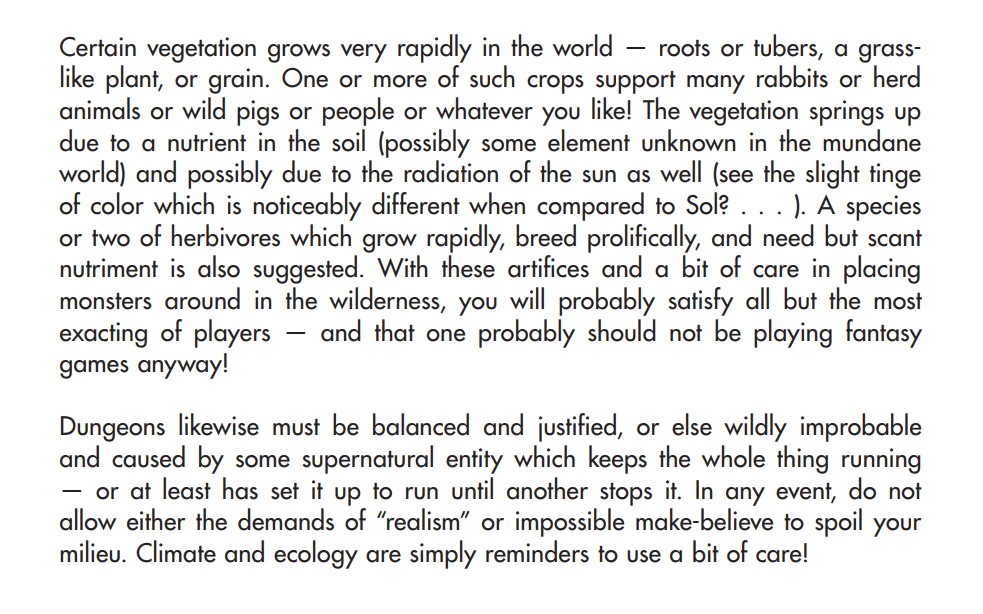
You can see that Gygax shows a notable scorn for both people who do too little and for those who demand too much. Dungeons must be balanced and justified, but demands of “realism” spoil the milieu, as do demands of “impossible make-believe”.
Origin:
Gygax demonstrably held these ideas as early as OD&D’s publication in 1974, and is explicit about them in the AD&D Dungeon Master’s Guide (1979). The term was coined by James Maliszewski of the blog Grognardia (2008).
Trope Codifiers:
- B2: Keep on the Borderlands and G1-G3: Against the Giants. Specifically, the introduction of women monsters, children monsters, and pets. Most infamously, orc and kobold babies have spawned morality debates to this day.
- The Ordning. Gygax laid the groundwork with a set hierarchy of giants; Troy Denning formally named it in AD&D 2nd Edition. The Ordning is considered a crowning example of Gygaxian Naturalism.
- Dungeon Cleaners. The gelatinous cube is Gygax’s original “clean-up crew”, created to explain why dungeons aren’t buried in filth. The Carrion Crawler fills the same ecological niche, feeding on corpses. Holmes carried them forward, reinforcing this piece of ecology.
Design Logic:
Gygaxian Naturalism is not itself a dungeon design ethos, nor should the trope codifiers be copy-pasted into our own dungeons. Adding innocent children and The Ordning to your dungeon will not make it better. Understood as a commentary on the extremes of monster hotels and GURPS-level simulation though, it’s a useful term for centering yourself rather than going too far down an unproductive road.
Contemporary Use:
Gygaxian Naturalism is a useful standard for how much explanation a dungeon needs. It’s a pity, then, that it’s also easily turned into a cudgel. Because Gygax is the father of the hobby, an invoker can use this as an argument from authority, and structurally, “Gygaxian Naturalism” is very flexible. Gygax himself calls for temperance, sets himself against full make-believe with no rhyme or reason, but also against the anti-fun police who demand realism in everything. A term that condemns both extremes can be invoked from either side. Against someone asking too many questions: “It’s Gygaxian Naturalism, man, let it go.” Against someone fine with letting anything fly: “You claiming anything is okay because it’s make believe is a problem with the modern mindset – we need to go back to Gygaxian Naturalism.” Both uses are to win an argument, rather than to convey a perspective.
The progressive use still exists. Gygaxian Naturalism is a supportive bit of critical vocabulary. It can reassure someone by showing them what “enough” can look like, if they don’t know. Designers who can’t stop explaining every detail – and so never reaches publication – might benefit from hearing that Gygaxian Naturalism is this concept, this standard, where nobody is demanding they ‘explain everything’. Ultimately, the call to put a bit of care into your worldbuilding, without stressing too much about it either, is a productive one.
Megadungeon & Kilodungeon
Definition:
A megadungeon is a dungeon large or complex enough to support an entire campaign by itself that employs Gygaxian naturalism. In practice the term exists in two senses: the definition just stated, and a looser definition where any very large dungeon with this sense of ecology would count. A kilodungeon is a small megadungeon – it still requires multiple distinct subsections (floors or themed sub-areas) and has roughly 100-300 rooms. A megadungeon exceeds a kilodungeon in both subsections and rooms.
A common misconception is that “supports a campaign by itself” is synonymous with “players are banned from leaving.” Not so! Most megadungeons not only allow excursions to town or side-quests elsewhere, but require them to some extent, to avoid player burnout.
Origin:
The form predates the term. Castle Greyhawk, Gary Gygax’s home campaign, was conceived as early as 1972. “Megadungeon” as a term crystallized in the OSR Google+ community and first appears in print in the Polyhedron #144 (Oct 2000) article, “Ecology of a Dungeon.”
Kilodungeon emerges as a tentative marketing term in 2018 by Autarch, meant to distinguish a 200+ room product from ever-larger published megadungeons. It has since been adopted as a game design term – more on this in Contemporary Use.
Trope Codifiers:
- Megadungeons: Castle Greyhawk, Caverns of Thracia, Stonehell Dungeon
- Kilodungeons: Secrets of the Nethercity, Pestilence at Halith Vorn
Design Logic:
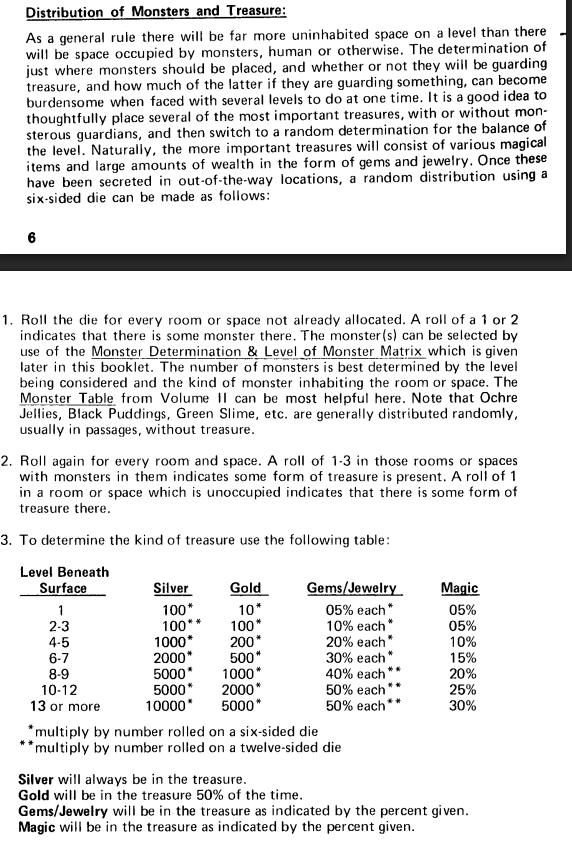
Unlike monster hotels, this style of dungeon has explicit structural guidance. OD&D gives us a truly onerous procedure, which I mention only because it is the original, and henceforth ignore:
Basic D&D cleans it up a bit, but the part worth screenshotting is Mentzer’s summary of the procedure’s effects. His summary is what the OSR quotes and uses today:
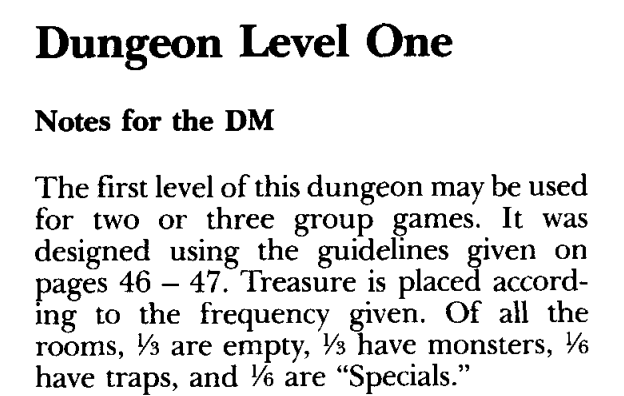
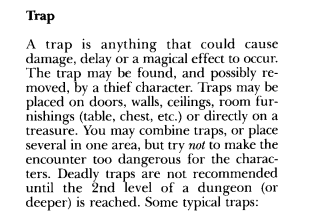
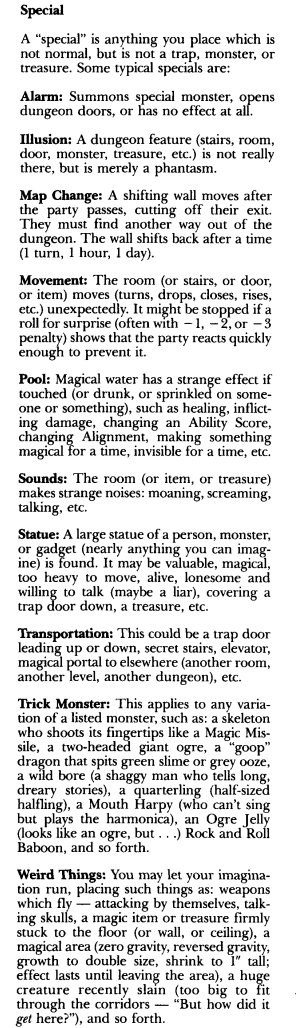
Room contents for a typical dungeon – and a megadungeon – should be 33% monsters, 33% treasure, 16% empty, and 16% traps.
Monster hotels had no such guidance – they’re built by feel – but the ones I own all happened to cluster near 70% monsters, 25% treasure, 2.5% empty, and 2.5% traps.
The direct contrast shows exactly what changes once you codify some ratios.
| Room Contents | Megadungeon | Monster Hotel |
| Monsters | 33% | 70% |
| Treasure | 33% | 25% |
| Empty | 16% | 2.5% |
| Traps | 16% | 2.5% |
For standard B/X dungeons and megadungeons, play is expected to involve the full ruleset – marching order, faction politicking, mapping, route experimentation, listening at doors, fighting dirty, and evading fights that look dangerous. One understated facet of player behavior: the original megadungeon was built for players willing to devote years or even decades to old-school D&D, and their slower pace (even in modernized megadungeons) reflects that different play norm.
Contemporary Use:
The astute reader will note an oddity when I say that the pure definition of a megadungeon requires no room count. Indeed, some of Jennell Jaquays’s best work, Caverns of Thracia and Dark Tower (just over 100 rooms each), are routinely called megadungeons in retro-review spaces on this basis, rather than kilodungeons.
We can understand this by considering how room counts have climbed over time: Castle Greyhawk had 122 rooms and was considered titanic for its time; Temple of Elemental Evil had 400+. The OSR then ballooned the scale – Stonehell Dungeon (2009) has over 1,000 rooms. The Halls of Arden Vul, started in the early 2000s, promised over 2000+ keyed encounters. A second term of some sort, even if it wasn’t necessarily “kilodungeon”, was inevitable, and it was always going to make a mess of taxonomy. “Kilodungeon”, applied fully, keeps a 200-room product from looking miserly beside the giants, but also demotes a legendary module like Caverns of Thracia to a kilodungeon. The resistance to this can be seen as a sort of “grandfathering in” of legacy dungeons, which leaves us with some rule-breakers in the taxonomy.
Funhouse Dungeon
Definition:
A dungeon with no logical ecology, not even Gygaxian ecology. It rejects both full realism and the relaxed naturalism Gygax argued for: the dungeon need not make sense as a place, only as an experience. Expect rooms of monsters and treasure, yes, but a heavier emphasis on traps and puzzles. Matthew Colville has a fine video on the subject.
Origin:
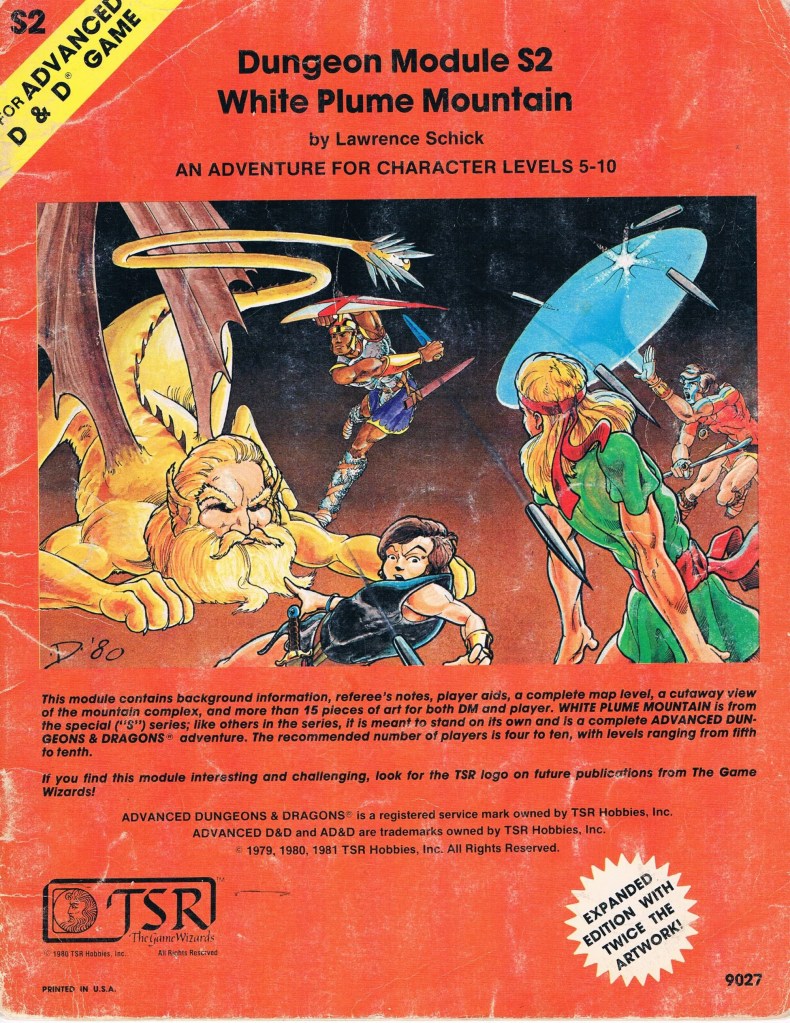
The term is used as far back as the early ‘80s to describe modules like S2: White Plume Mountain (1979), the ur-example of this sort of dungeon. Its exact origin is lost to time.
Trope Codifiers:
- S2: White Plume Mountain
- X2: Castle Amber
- Mortzengersturm, the Mad Manticore of the Prismatic Peak
Design Logic:
Funhouse dungeons are a countercultural response to megadungeons – more accurately, to the playstyle megadungeons engender. Recall from earlier that the megadungeon asks the player to devote years to the hobby and take it seriously: to treat the navigation of dungeon spaces with respect, to get into character, to buy into the epic adventure. The funhouse offers an evening playing D&D without any of that. Sometimes it is employed as a campaign premise to keep things light, sometimes it is inserted mid-campaign as a tonal shift – perhaps because a player’s life has taken a turn for the worse and a ridiculous evening is more therapeutic than a somber one.
For room contents, ratios carry over. Room contents should still sit near 33% monsters, 33% treasure, 16% empty, 16% traps. Those are pacing considerations, independent from tone. Treasure drives EXP and monsters drive stakes; those are baseline assumptions of old-school D&D, and silliness doesn’t change them.
Play still engages the full ruleset, but player skill is tested far more directly, often in fourth-wall-breaking ways. Crossword puzzles, literary references, cameo appearances by characters the players know – all fair game. The sphinx variants (androsphinx, criosphinx, gynosphinx, hieracosphinx) entered the Monster Manual in AD&D partly to support this: riddle-monsters, statted for the GM’s convenience. The goal is to challenge the players, which takes the shared skill of a trivia night host, a teacher, or a therapist: knowing your subjects. Ordinary GMing practices for strangers won’t substitute well.
Finally, funhouse dungeons bring back one of the few benefits of the monster hotel: they let the GM introduce monsters the players would otherwise never meet. Because the dungeon doesn’t have to make sense, an iconic monster can appear without the legwork of justifying its existence, its neighbors, or its impact on the setting.
Negadungeon
Definition:
To be continued…
Trope Codifiers:
- Death Frost Doom
- The Isle by Luke Gearing
Jewelbox Dungeon
Definition:
To be continued…
Trope Codifiers:
- Tomb Robbers of the Crystal Frontier
- The Curse of Mizzling Grove


Leave a Reply