
It’s the early 80s. You’ve just discovered Dungeons & Dragons and decide to give B/X D&D a whirl with your friends. You roll up a cleric, and come across the Turn Undead table for the first time. Depending on which version of the Basic Set you are playing, the table might vary, but one thing stays the same…
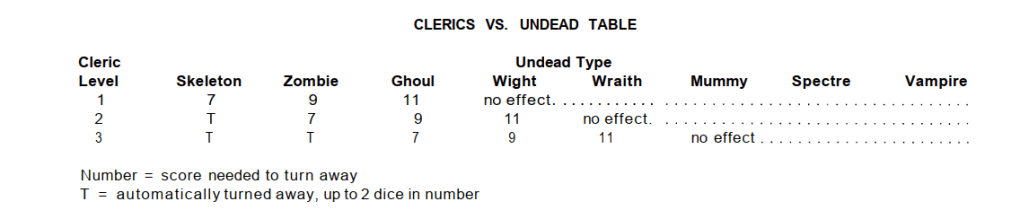
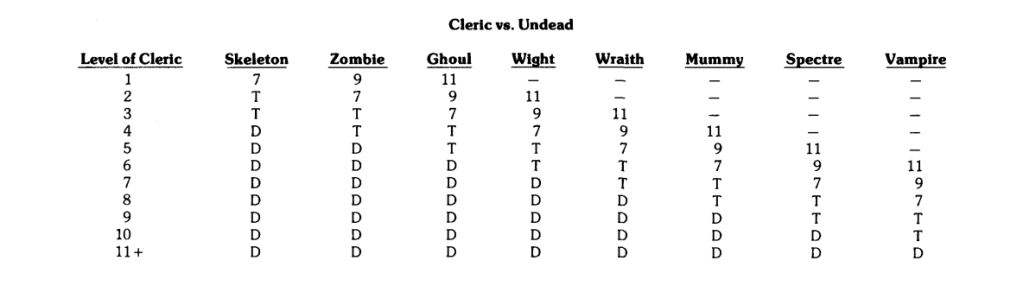
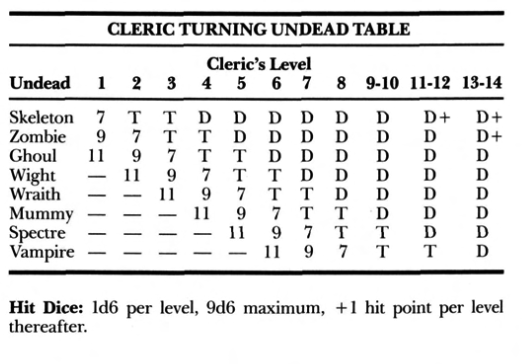
…it lists specific undead by name. This isn’t always the case with modern retro-clones of B/X…

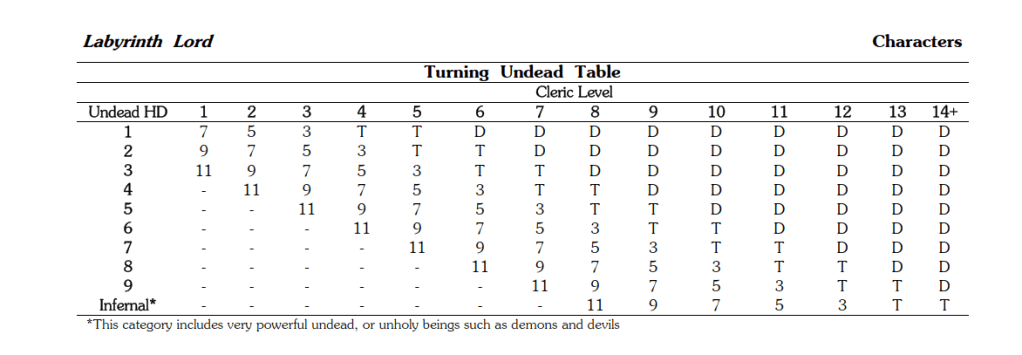
…where undead are often grouped by Hit Dice. Nor is it the case with the 5th edition of Dungeons & Dragons, where all undead are covered by a Wisdom Saving Throw.
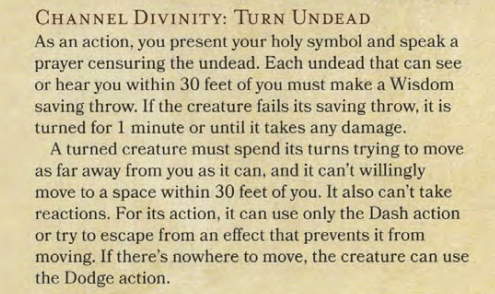
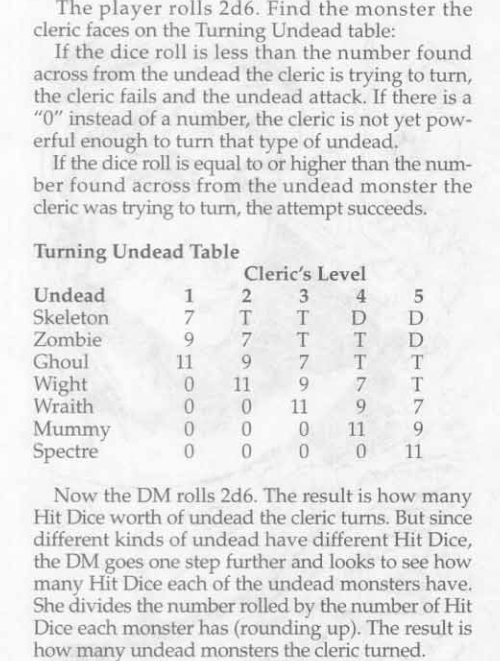
Going back to our scene in the 80s: what’s interesting is that you don’t just have a sample listing of undead that might be in the game – you had the complete roster of undead monsters in the game.
You knew, before any play at all, that ghouls were stronger than zombies, which outmatched skeletons. Vampires meant serious trouble. And if you met a monster not on that list? You could confidently tell your party that it wasn’t undead – and you’d be right. In fact, you would have been right for a 9-year span of play – from the first Basic Rules in 1977 until Night’s Dark Terror in 1986, when the first undead not on the table finally appeared. To me, this was a pretty incredible discovery – it meant that clerics would have been not just the specialist in the party for leveraging against undead, but that in a way, clerics were pseudo monster experts. This is before “goblinoids” or “giants” or “celestials” were added to the taxonomy. Back then, there were normal monsters, which made noise, had to roll for morale, and typically had potentially complex motivations, and undead, which were silent, never faltered in combat, and were just there to kill you. That was it. And for 9 years, the cleric player could eliminate any ambiguity on whether you were facing an undead or a normal monster, as well as having the tools to potentially turn the undead encounter into a cakewalk. That added aspect of the cleric having this meta-knowledge was just something I’d never heard of before.

You can actually see something interesting in the way this undead, the Wyrd, is presented – it is defined as being turned with the same probability as that of a wraith (even giving the page in the Expert rules where the Turn Undead table could be found). This phrasing isn’t that unusual to anyone who used gaming materials in the 80s, but stands out maybe to modern players. Here is a monster who is being defined not based on its stats, or even hit dice, but by the way clerics turn a different monster.
This quirk of undead has never really been revived in the OSR scene (and who knows – as I go along this journey it may turn out to be for good reason). Sometimes the Turn Undead table is by HD, denying clerics that extra meta-knowledge that would have helped differentiate their class in the first 9 years of B/X. Other times the games introduce multiple types of undead outside the classic list. Some even treat unfamiliar monsters as a feature, especially in weird fantasy OSR games Dungeon Crawl Classics, Neoclassical Geek Revival, Into the Odd, Goblin Laws of Gaming, or Lamentations of the Flame Princess. In those games, GMs are encouraged to throw gonzo, one-off horrors at players that nobody recognizes.
The imagined game context I present above, where clerics have a full list of all undead the party may face, suggests a very different sort of old-school scene: one where player agency partially arises from knowing how to tactically react to monsters, because they know what they’re going to face. The cleric’s table isn’t just a mechanic – it’s a tactical cheat sheet. And it fits with my general impression that B/X-style games function better with repetitive fights against monsters you can learn the behavior of, rather than with one-off battles with novel monsters you will never see again.
All of this may seem a small thing to you, reader, but for me, it forced a design question: what sort of undead belong in my game, The Odd & the Wild? Do I want the undead to span a variety of undead that aren’t player-facing, but are fairly self-explanatory, like in 5th Edition? Do I want a fixed, cleric-known roster, like in early B/X? Or should I learn into gonzo undead like in weird fantasy OSR games*, with very little space given to mundane undead like skeletons and zombies?
*Sorry, really brief aside here. Because I know it will come up: B/X also has its own provisions for special, never-before seen monsters. You can find this guidance in Mentzer, though procedurally a Trick Monster is a subtype of a Special dungeon room, so the expectation would have been for them to be fairly rare.
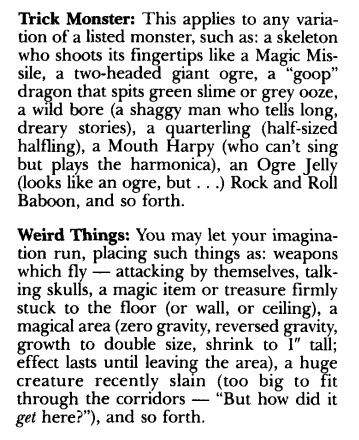
The idea was that Trick Monsters, as in the advice above, only worked against a background of regular monsters. So it’s slightly different than the prolific gonzo monsters that are endemic to the games I brought up earlier.
As of the writing of this blog post, I’m committing towards the early years of B/X. Which brings me to the next question. Which undead, and what abilities, should make the list?
First, I ported the original roster of undead into TO&tW’s mechanics to get a feel for things. I used the slightly shorter Denning/Brown edition of the undead table to make this project more bite-sized (it excludes the vampire):
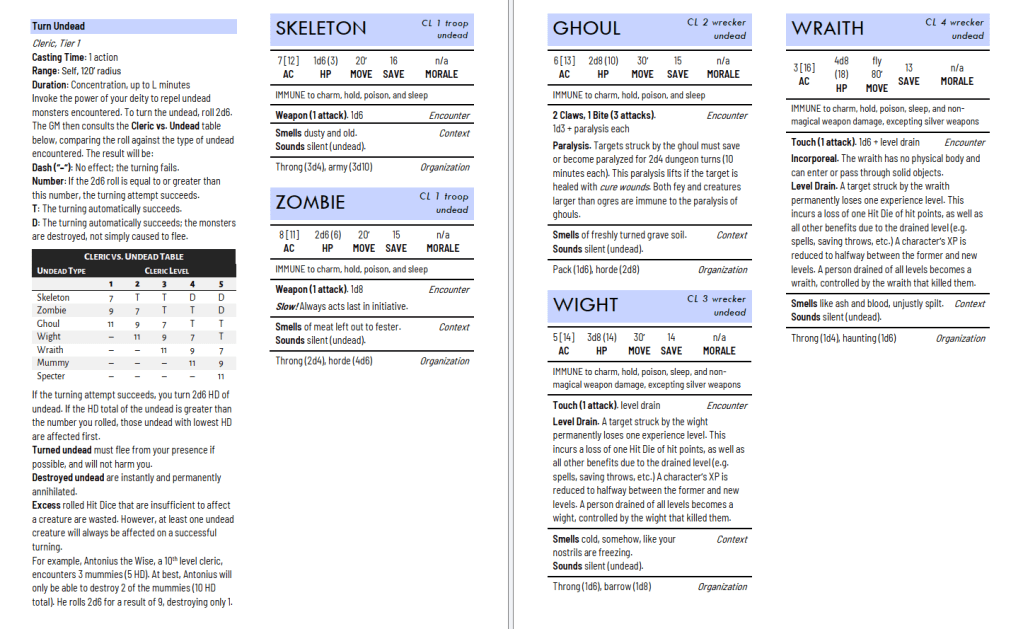
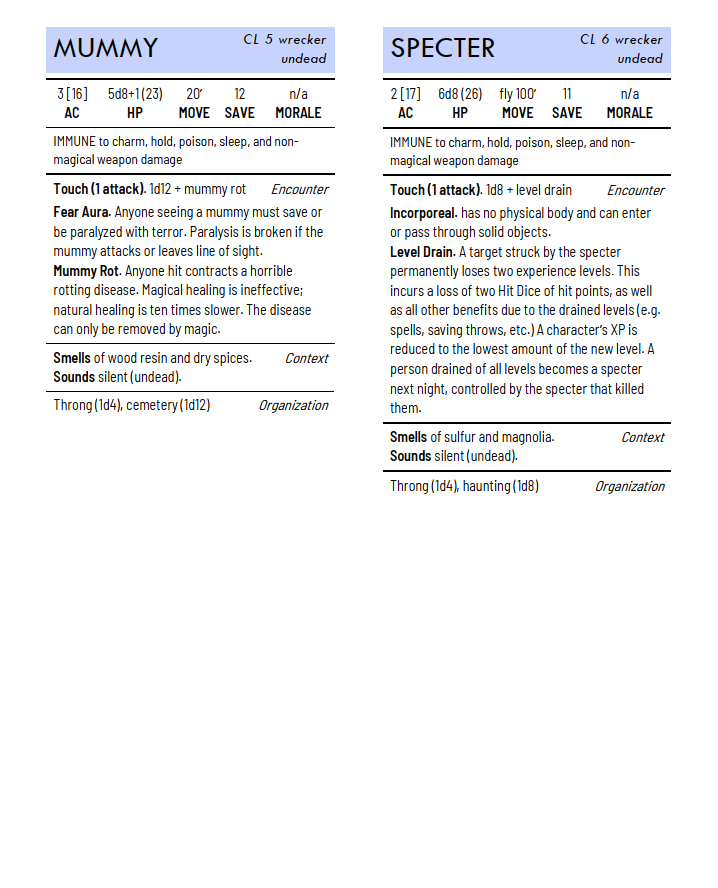
Skeletons and Zombies have their infinite morale and lack of sound as the unifying feature, but they aren’t likely to trigger any difference in however your players are already approaching a dungeon. At most, they might inspire the occasional flaming oil trick.
Ghouls change the game. Their paralysis threatens TPKs, pushing smart parties to shield the cleric from front row marching positions at all costs. In B/X, elves were valuable even with their slow leveling curve because of their immunity to ghoul paralysis.
Starting from Wights onward, undead become capable of the dreaded energy drain attack, capable of wiping out your hard-earned levels. Spot one, and retreat becomes plan A – you either want to bypass its room with another route, or bring in overwhelming firepower to take it down safely. Every lost level hurts more as experience costs balloon, so wights remain scary even to high-level parties.
Mummies stand out from the rest of the undead, not having energy drain and having their unique mummy rot that they can inflict upon characters.
Finally, wraiths and specters share incorporeality – though the original rules handle it…loosely. Just look at this:
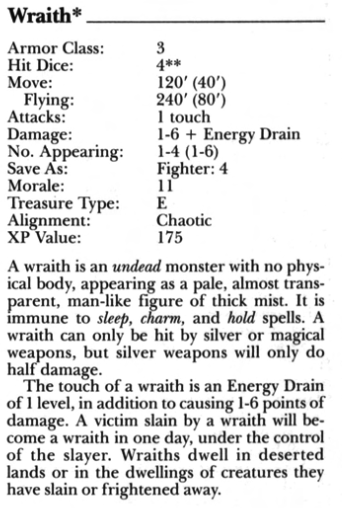
Just “no physical body”. No explanation of how that works. Figure it out! I love it and I hate it at the same time – my typical reaction to most early TTRPG texts. The implied trust in GM competence makes me happy, but the lack of clarity in designer intention…argh.
Anyway.
My goal is to have a set roster of undead. Here are design goals for my own undead:
- Undead abilities should follow clear progression.
Players who notice an ability and who prepare for it should be rewarded for doing so, without receiving mixed messages as the undead suddenly change to new, unrelated abilities and lose established ones. For instance, I dislike the incorporeality gap between 4 HD wraiths and 6 HD specters, while the 5 HD mummy doesn’t have that ability. Along similar lines, I don’t like that mummies break the energy drain trend; they should share key traits with the undead bracketing them.
I’ll be the first to acknowledge that, compared to most modern video games, the progression of undead in D&D will always be more loose and less regimented…so maybe a more accurate design goal is to simply improve a bit from what B/X did. - Ditch panned mechanics.
There is a lot of digital ink spilled on level drain, much of it critical. It’s one of the easiest places to get people of different D&D backgrounds to agree that the old-school design ethos may be outdated and in need of a fresh coat of paint. While less writing can be found to criticize incorporeality, several of my 5e GM friends who played with it more than I have told me it was clunky in their games when I asked about it.
I’ve decided to replace both.
Consistency still important. Whatever replaces energy drain, for example, would apply to mummies still. - Have the game be compatible with adventures made for B/X D&D.
I wanted my own, changed undead roster to be able to be substituted in pretty easily for the ones I was replacing.
By and large, I think I have succeeded, though there is still some fine-tuning to be done…here is my Turn Undead table, and my roster of undead.


The only serious hiccup is the spectral hound, a monster I love from the Swords & Wizardry bestiary, Monstrosities. It now occupies the mummy’s old slot.

Yes, players might raise an eyebrow if every sarcophagus contains a ghost doggo. Be flexible here. I’m being indulgent. I like ghostly dogs.
Otherwise, I think this is a fine list. Poes from Legend of Zelda replace wights, introducing the Doom mechanic more elegantly, thanks to the iconic Poe lantern telegraphing their position. I even have them fly as slowly as the Wight would have chased you, so you can run away from them properly. The Doom mechanic involves an incremental score starting from 0 that doesn’t do anything unless it reaches your current level, at which point Doom causes you to perish instantly. This way I can have it function as the same danger that level drain would, without the bookkeeping of removing class levels or the player feeling like they are in a death spiral. The mechanics behind Doom might be explored in a future blog post – the focus of this post is on undead. Just think of it as a level drain replacement for now.
Mummies are introduced earlier, which given their prolific existence across old modules is I think also a good thing. I would probably just run my mummies in the same place as the mummies in old modules – my “nerf” to hardly matters, as mummy encounters and mummy dungeons are brutal enough. I’m also giving them a way to increase Doom, though it is much more forgiving than with other undead.
I introduce wall-phasing and spectral strike (armor-ignoring attacks) exclusively for the two most dangerous undead. Since my game becomes more explicitly “combat as sport” the higher level players are, I thought this decision fit in with the rest of the game’s design.
That’s all for this post. I encourage other OSR designers to consider the Turn Undead list themselves. Since energy drain is widely disliked, why not rethink your own Turn Undead roster? We have so many reworks of the Cleric and even of Turn Undead into a spell (as I do here), but I couldn’t find any reworks of Undead. It’s fertile ground for experimentation.
As for new OSR players: seek out TSR-era dungeons that specifically feature some of these undead. Nothing clarifies the cleric’s classic role quite like facing a ghoul’s paralysis or a wight’s level drain firsthand.
 Dungeon Antology
I’ve never thought about the Turn Undead table as a “cheat sheet” but you’re absolutely right! Very interesting!
LikeLike