Introduction
I’m writing a series of posts on OSR dungeon design: specifically, how to build a Wandering Monster table for your dungeon the old-school way, and how monsters have served as building blocks for dungeons throughout the history of our hobby. The series is part history lesson, part design exercise. I want to cover four snapshots in time – four moments where monsters were used in a particular way.
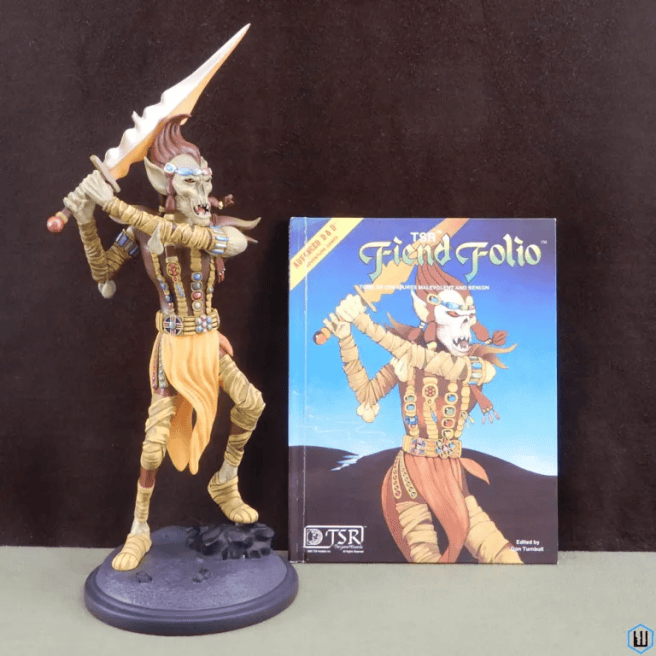
Each snapshot offers its own lessons from the designers who came before us, which we can then use to sharpen up our own handling of monsters. We begin not with Original Dungeons & Dragons but with Holmes Basic (the OD&D little brown books, the unwritten rules culture from the wargaming tradition, and the multiple supplements are a pain to sort through; for me, Holmes is where the trail becomes walkable). We will proceed with Moldvay/Mentzer Basic in parallel as a single blog post, move a bit back in time to the Advanced Dungeons & Dragons Monster Manual as a third post, and end, eventually, with the Fiend Folio.
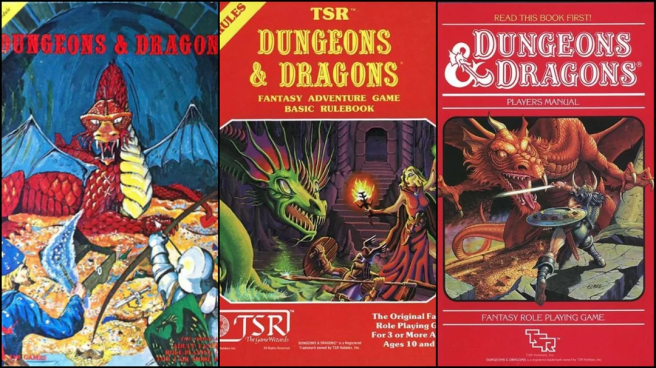
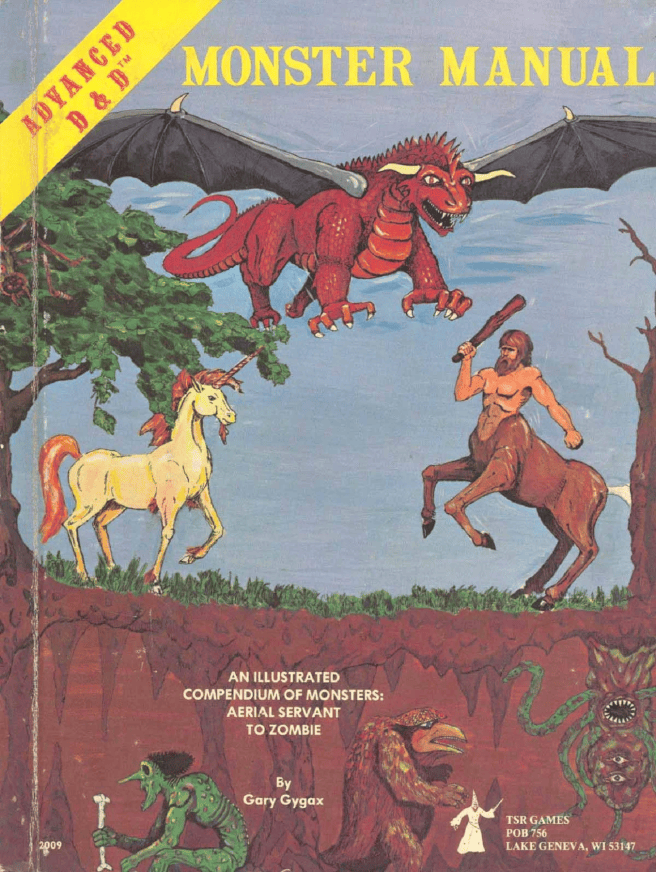
Historical Context
Holmes Basic lands in 1977, and it is a remarkable product: a shift in the game’s audience, proposed entirely by an outsider to Tactical Studies Rules (TSR). Inside the company, Gary Gygax is toiling away at what will become his magnum opus, Advanced Dungeons & Dragons. At this point, all D&D comprises of is three little brown books and a heap of oral tradition, opaque to anyone not already entrenched in the culture.
Eric J. Holmes is a professor of Neurology at the University of Southern California, working in the school of medicine. One of the early adopters of Dungeons & Dragons in California, moving between the Caltech and Santa Monica groups, he reaches out to TSR all the way in Lake Geneva, Wisconsin, with a proposal that would change the history of the game: he offers, pro bono1, to build an introductory version of D&D, cleaning up and compiling the booklets, wargaming assumptions, and oral tradition.
He set out with the goal of teaching people how to play, which up to that point had not been a priority at all. He started a trend that would span multiple authors – himself, Tom Moldvay, Frank Mentzer, and Troy Denning2 – each taking their own stab at making “Basic” D&D: a version newly inclusive of middle schoolers and high schoolers who had never played the game before.
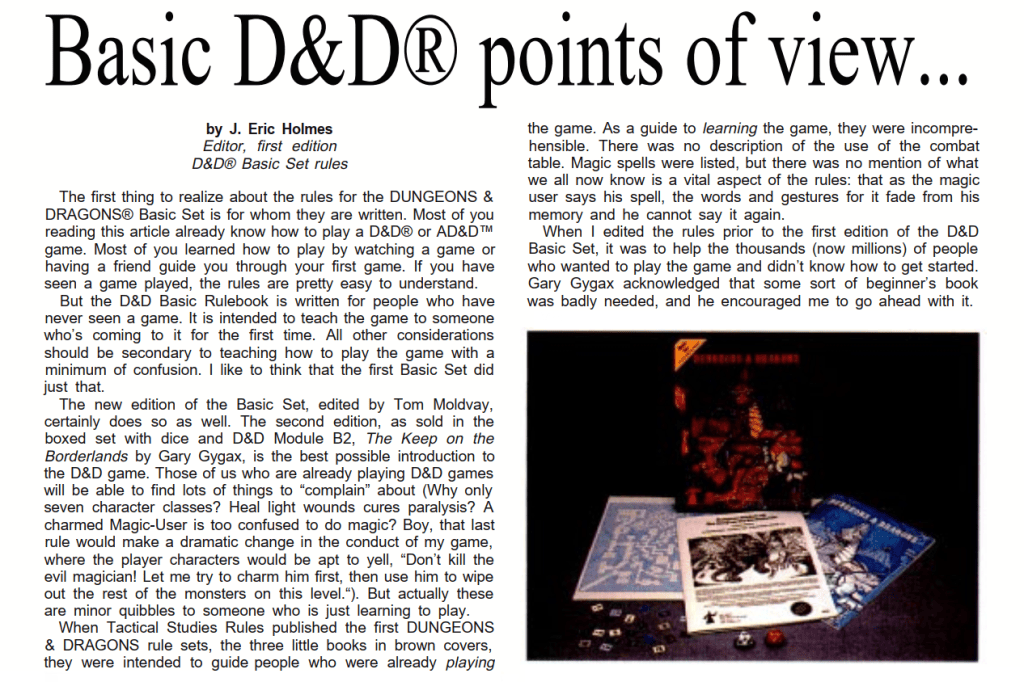
TSR said yes, and the Blue Book came into being.
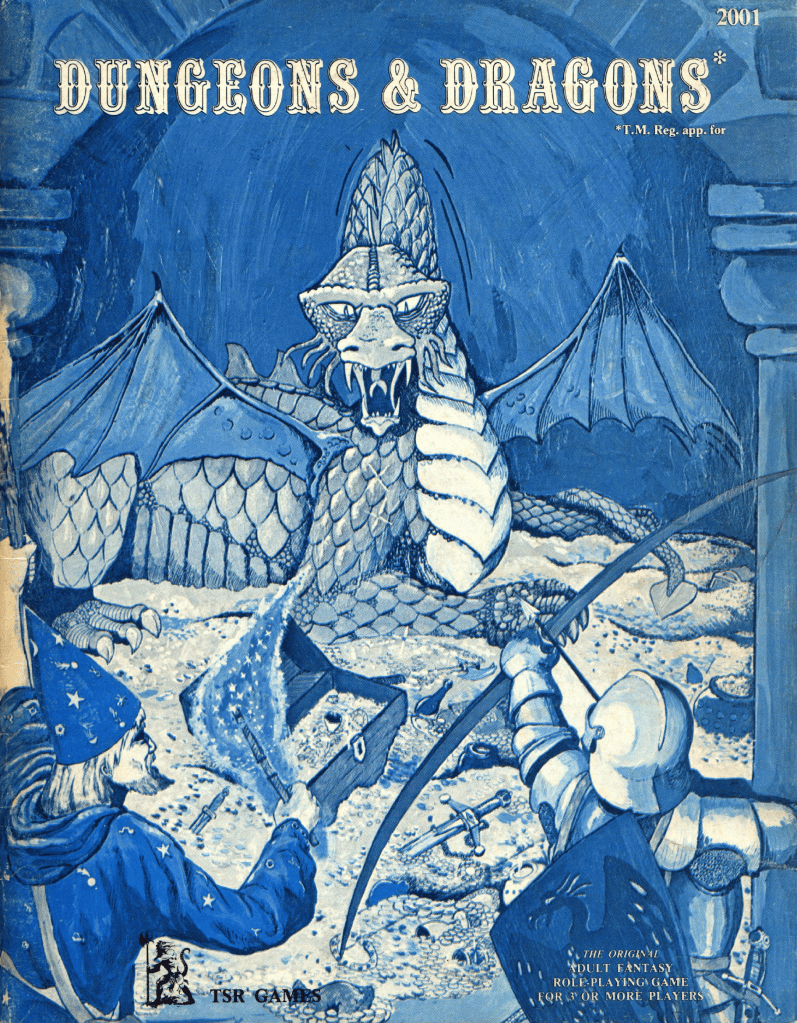
An aside on nomenclature: around the internet and among fans, you will hear this edition of the game called many things. Holmes Basic, Holmes Blue Book, Holmes D&D. Same book – it’s all referring to the above volume.
Lessons from Holmes Basic
We won’t get too much into monster design in this post. That analysis is more useful when we can compare different takes on the same monster. For now, let us just get some bookkeeping out of the way. What is the purpose of wandering monsters? Engaging with the OSR movement, you’ll hear all of the following answers:
- They punish idle time the party spends in the dungeon.
- They force attrition of resources, by wearing down hit points, spells, and healing potions in addition to room monsters.
- They teach risk management, as by design wandering monsters carry little or even no treasure, making them a “bad deal” economically.
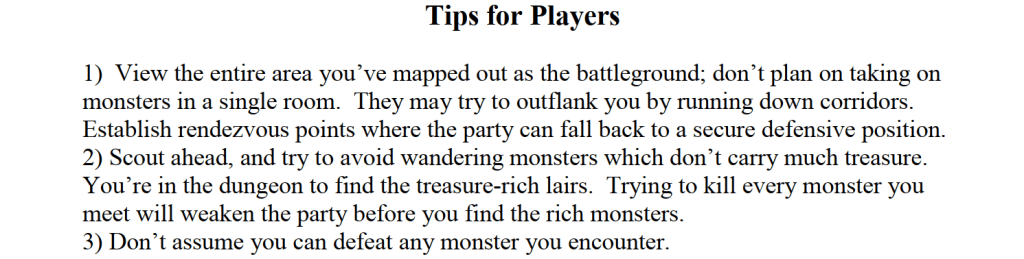
- They shape player strategy: a party aware that wandering monsters may show up will always be a little more cautious, since the number of enemies can always be unexpectedly inflated.
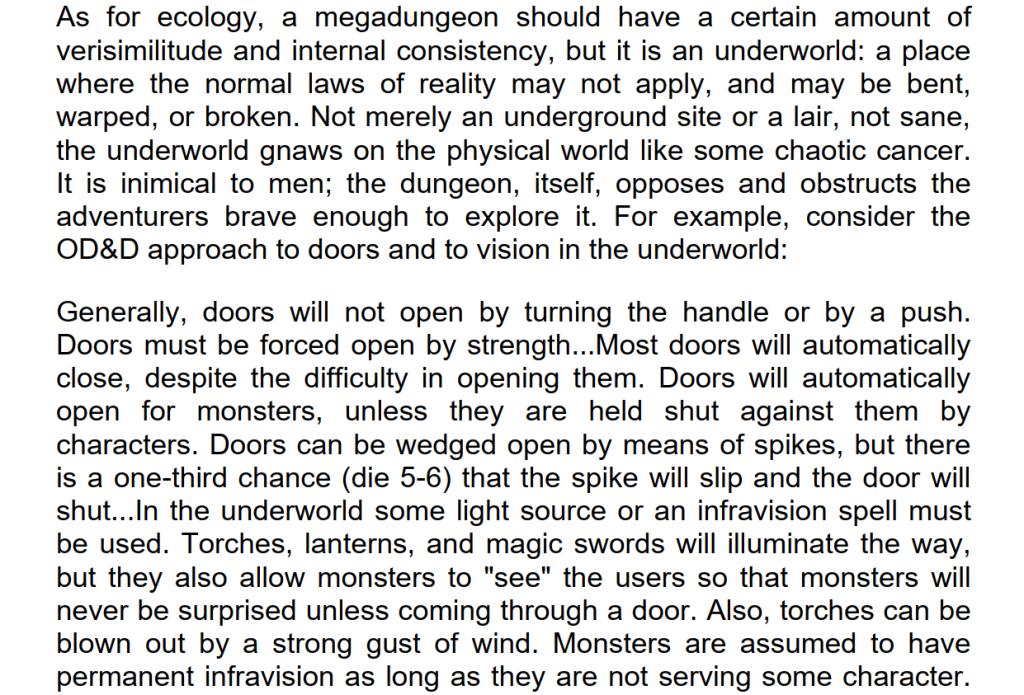
- They make the dungeon feel inimical to human life, with doors and monsters set against the party’s presence (though as we’ll see, this is far more true of OD&D/AD&D. Basic D&D, after all, has plenty of human life in its wandering monster tables).
- They reinforce time as a game mechanic, with the “dungeon turn” directly tied to wandering monster checks.
- They give the GM a tool to reach for when the party makes noise, burns too bright a light, takes too long on a task, et cetera.
- They encourage players to go deeper into the dungeon (?) – or so I’ve heard. I’m mostly parroting this one, because I’ve never found it true at my tables.
But this is 1977. None of that vocabulary exists yet. No one has written the blog posts, coined the phrases, or codified this supposed purpose.
What does Holmes say about the purpose of wandering monsters, before all this?
At the end of each three turns the Dungeon Master can roll a die to see if a wandering monster has come down the corridor. A roll of 6 means that something has come “strolling” along. If the party has someone watching they will see or hear the monster up to 120 feet away unless it is coming around a corner, very quiet, etc…
The number of wandering monsters appearing should be roughly equal to the strength of the party encountering them. First level adventurers encountering monsters typically found on the first level of a dungeon should be faced with roughly equal numbers, i.e. a party of three would encounter 2-6 orcs, 3-12 giant rats, etc. However, if the party were second level, or the first level monsters were encountered on the second level of the dungeon, the number of wandering monsters encountered should be doubled. If justification is needed, simply consider that a small party is relatively quiet, thus attracting less attention than a large group, and powerful characters will similarly bring more numbers of monsters. The basic number of monsters appearing in an encounter with wandering monsters is shown in parentheses after each monster. Modify the number as required to suit the situation. Roll the appropriate die or dice to generate the random number falling within the parameters indicated for the possible number of the specific type of monster the party has encountered, and then adjust the number according to your modification. Numbers should not be reduced below the lowest [possible] number.
Obviously, some of these creatures will not always be hostile. Some may offer aid and assistance. To determine the reaction of such creatures, [make a Reaction roll].
The Dungeon Master should make adjustments if the party spokesman has high charisma or offers special inducements.
If the party decides to flee they may be able to delay pursuit by discarding some of their possessions. Unintelligent monsters will stop to pick up food half the time and intelligent monsters will stop for treasure half the time. Burning oil will deter monsters (referee’s discretion).
Bear in mind that this is the first time the mix of oral tradition and rules scattered across multiple booklets have been compiled in one place. Where OD&D offers no guidance, Holmes injects his own numbers, his own sense of game balance and game design. That is where understanding his intention, that this be a “basic” version of the game targeting younger players, matters. Notably, the 1-in-6 chance of a monster coming once every three dungeon turns is lower than what later editions would use.
I also want to do somewhat of a close reading of a few specific implications of this passage:
Come “strolling” along. This tells us a great deal about how Holmes sees the wandering monster. It is not hunting the party. It is not waiting in ambush. It is not even aware of the party – merely going about its business in the dungeon. The casualness of “strolling” is no accident; Holmes even highlights it in quotations. And while this may be a stretch, the word also conjures a domestic air. The dungeon, hostile as it may be to adventurers, is just a residential facility to the monsters who live there – thusly do they stroll about it.
Unintelligent vs. intelligent monsters. Old-school Dungeons & Dragons often buckets monsters into three categories – unintelligent, intelligent, and undead. We see an example of it here: unintelligent monsters react identically to food, and intelligent monsters have an identical reaction to treasure, albeit both modulated by probability. This hints at a “metagame” of default tools players can use against enemies. When I run old-school games, I introduce my players to this “metagame”, since the modern player has no way to pick it up, whereas the old-school player inherited it by word of mouth. In brief:
Unintelligent monsters can’t be reasoned with, but the lead character’s Charisma still affects first-impression reaction rolls. If you think a dungeon is mostly unintelligent monsters, put high Charisma and high AC for your front and back ranks in marching order. They often have lower morale – modeled off of skittish wildlife. They can be distracted with food to cover retreat, and typically won’t pursue through burning oil.
Intelligent monsters can be reasoned with. Charisma matters, but whoever speaks can “take the initiative” on applying it to reaction rolls. If you think a dungeon is mostly intelligent creatures, only high AC is important for your front and back ranks in marching order. They can be distracted with treasure to cover retreat, and typically won’t pursue through burning oil.
Undead monsters can’t be heard at doors – they’re preternaturally silent. They have no morale failstate and fight to the death. If you think a dungeon is mostly undead, keep your cleric safe in the marching order so they can’t be downed before Turn Undead. Undead can be distracted as per their intelligence, but unintelligent undead often pursue through burning oil, heedless of the damage. Exploit that in combat, but don’t expect fire to deter pursuit if retreating.
Pursuit and escape are a viable and expected outcome of encounters. Holmes spends a full paragraph on fleeing. He assumes that fleeing is common, and that the rules are not an afterthought, but a core part of the encounter system. This is not a game where every encounter is a fight to the death. Survival often means running – and the rules support that.
Okay. We’ve gone through what wandering monsters are for, and what they are about. Without further fanfare, here is the Wandering Monsters table for Holmes, copied over for greater legibility.
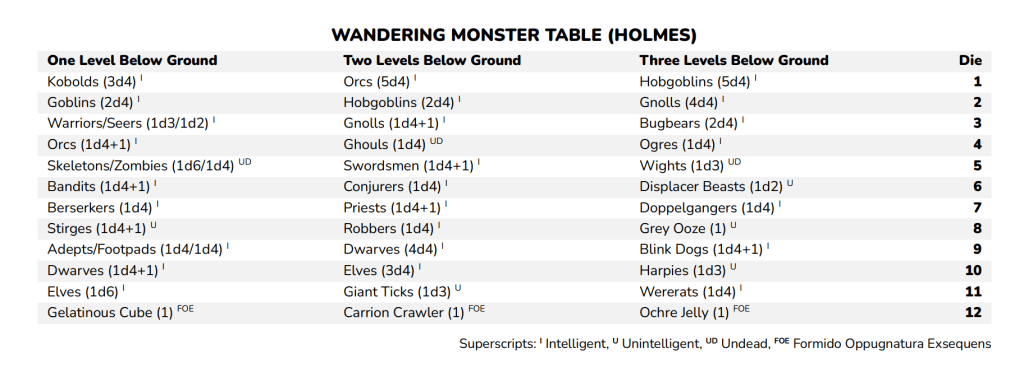
As mentioned, Intelligent, Unintelligent, and Undead monsters are three categories worth keeping in mind. How they are distributed across each dungeon level is worth delineating. But two additional categories present themselves here, and I’ll argue for both.
The first, though not listed on the table, is “people”. You see Warriors (title for L2 Fighters), Seers (L2 Magic-Users), Adepts (L2 Clerics), Footpads (L2 thieves), Dwarves, and Elves, six of the seven core classes in Holmes Basic. The sheer number of other adventurers populating these old tables implies a wealth of rival parties and fellow delvers.
It’s an undeniably compelling category, not least because so few modern dungeons, OSR or otherwise, employ this category anymore. Most people nowadays are pre-keyed to dungeon rooms rather than relegated to random encounters. Furthermore, this category persists across the old-school authors. Mentzer’s Basic D&D (1983) even has a cool segment on fitting randomly encountered people into the dungeon.
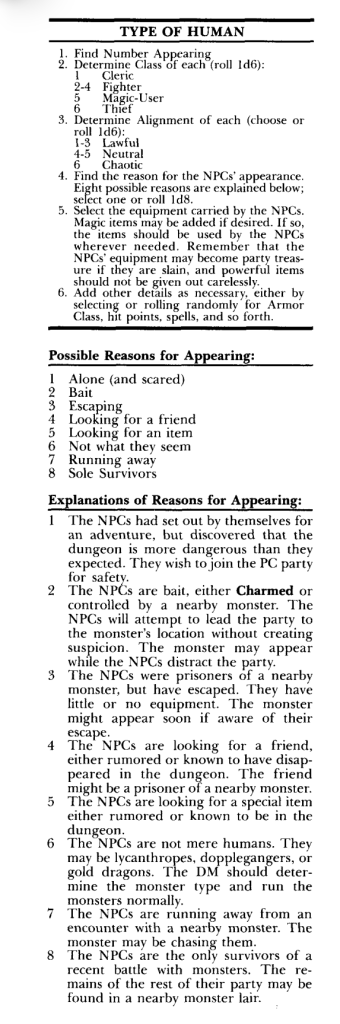
Despite all this, I elect to ignore this category for the remainder of my analysis. Partly, because so many modern dungeons make other people hard to justify. The dungeons are death traps. They’re in space. They’re extradimensional eldritch spidershark castles. Including people can be a fun constraint, but a difficult one, worthy of postposing for some future post. And partly, because I’m partial to the game design evolution of people as pre-keyed encounters myself. Keying lets you add specificity to your NPCS, fleshing out an entire room dedicated to introducing them properly. It also makes it easier to employ other dramatic tools to such introductions – leitmotifs, foreshadowing, and irony are all more available to us when people are keyed.
The second category exists only in Holmes and is ignored by the authors after him. I’ve cheekily labeled them FOEs (IYKYK) – enemies that punch above their weight class for the floor they are on3. Holmes includes one of these per floor. It is a deliberate way to introduce new mechanics as safely as possible in a game engine this lethal – and here, more than anywhere else, you can see his intention to make Holmes Basic a teaching game for younger audiences. The organizational choice seems pulled straight from early Mario design: introduce new enemies and mechanics in the safest environment possible, then let players acclimate.
With these categories in mind, we can do a frequency analysis of what our own wandering monster tables should look like, for the first two floors of a dungeon.
DUNGEON F1
75% of your encounters should be Intelligent monsters.
8.33% of your encounters should be Unintelligent monsters.
8.33% of your encounters should be Undead monsters.
8.33% of your encounters should be FOEs.
DUNGEON F2
75% of your encounters should be Intelligent monsters.
8.33% of your encounters should be Unintelligent monsters.
8.33% of your encounters should be Undead monsters.
8.33% of your encounters should be FOEs.
Furthermore, F1 and F2 share monsters. 25% of the encounters on both floors are shared, Intelligent monsters.
Putting it Into Practice
This first exercise is going to feel a bit precious, but as we do more and more of these, I hope that you’ll see the value of doing them so incrementally. Let us start by constructing a toy model dungeon to see what lessons we can take from this.
Years ago, kobolds dug a silver mine into the mountains (Dungeon Floor 1). The digging breached through to a humid pit (Dungeon Floor 2), home to the Mycenae, fungal colonists native to the Underdark.
The Kobold Mines, unless otherwise noted, have granite walks speckled with fine-grained, rusty-tan stones, rich in light-reflecting silica. There are no threads of silver; the mine has long been exhausted. Makeshift doors are pine logs lashed together with plant roots and bark strips. Unless otherwise noted, it is pitch black.
The Fungal Pit, by contrast, consists of limestone walls layered in honeycomb-like mats of frass – cricket faeces – some furred with glowing mold. Some walls look like collapsed passages, possibly old roads into the Underdark the colonists abandoned for safety. Doors are made of overlapping plates giant insect chitin. Unless otherwise noted, dim light from the glowing mold illuminates these rooms.
Both the kobolds and the Mycenae have hoarded treasure. Both have also harassed the local populace. Thus, it is a dungeon worth plundering, and Basic D&D adventurers have every reason to do so.
Our first random table keeps things simple. It consists entirely of the two creatures we would expect to inhabit the two layers. Kobolds and Mycenae, nothing else.
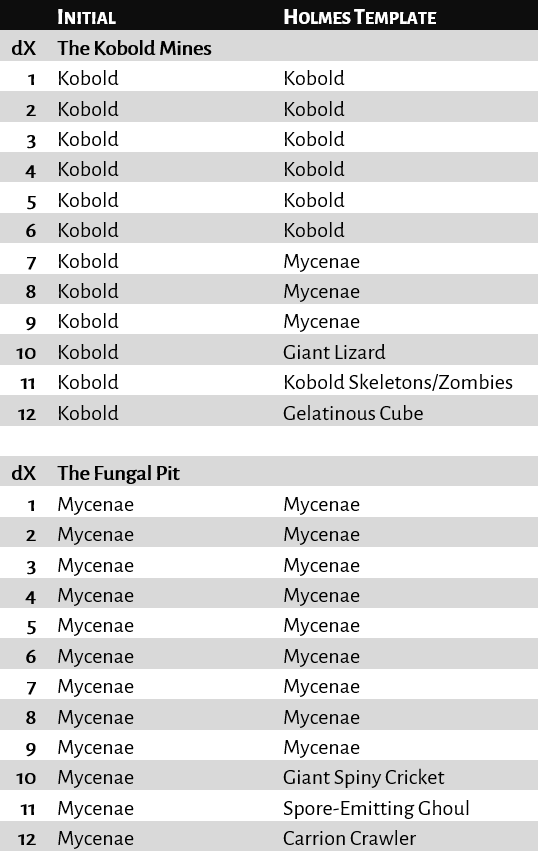
First, the texture of the dungeon is well-established. It’s tempting to add more diversity to the entries, but I’d hold off until we can come up with new “categories” of monsters, as I think diversity for the sake of teaching is more instructive than diversity for its own sake. Remember, also that players never see the actual table itself. They only see the monster in front of them. If they crawl about Floor 1 exhaustively, they might work out that it is mostly kobolds, with occasional mushroom-folk, a giant lizard, undead kobolds, and a gelatinous cube. Far more likely, a non-completionist party meets two or three of those before descending to Floor 2 – and for that campaign, those encounters are Floor 1. Room counts and particular wandering monster procedures will change the calculus here, but for now, assuming Holmes’s 1-in-6 chance to encounter a monster every three dungeon turns, and assuming a room count of 25-40, having a wandering monster diversity of 5-6 monsters is good praxis, from theory and experience alike.
Second, this creates a nice sense of “movement” between floors. Some Mycenae have ventured up to Floor 1. Whether the keyed entries show more of that upward drift is up to the dungeon designer, but the groundwork is laid just in the table alone, with no maps and no extra work. Even if the dungeon has no keyed rooms hinting at the Fungal Pit, there’s some minimum foreshadowing for what comes next.
Third, this table teaches the metagame of Basic D&D well, especially alongside a well-keyed set of rooms. With so many intelligent monsters, Reaction Rolls from parley and mutual Reaction Rolls between room monsters and wandering monsters see heavy use. Players have many insertion points to influence these reactions, since they can communicate complex ideas to intelligent monsters. The low amount of unintelligent and undead monsters means that marching order can be “optimized” to fit the monster frequency. And if players watch the wandering monster roll (which should be made in the open), they should notice how frequently intelligent enemies show up compared to other types – though in this case, the theming of the dungeon also helps. The stronger FOEs have a chance of jump-scaring players, though their rarity and Holmes’s recommendation to keep them as solo encounters both help players acclimate more easily.
It’s a solid foundation. With that, I’ll end this post. Next time: the Moldvay & Mentzer formulations of Wandering Monster tables, and the same exercise above with their choice of distribution. With two exercises behind us, we can also talk more about the differences, and the reasons why each can help us with our dungeon design. I also want to dig into the number of enemies encountered in more detail. As a final thing to look forward to, we still need to convincingly link the design of wandering monster tables to dungeon design – that too, will be covered in the next post.
Dungeonantology is up again. Welcome back.
Trivia!
Since this series goes edition-by-edition, I kept finding fascinating things that didn’t fit the main subject matter. As such, each of these blog posts get a short trivia section. For Holmes, two fun facts about his metagame, both almost certainly unintentional:
Holmes had to summarize Original Dungeons & Dragons as he understood it. Usually, his care as a professor served him well. But daggers are an amusing accident. OD&D uses Chainmail as its the combat engine, where daggers interact with armor differently from other weapons, giving them a severely reduced chance to deal damage. To compensate, daggers strike twice per round. Holmes, cross-referencing so many rules and oral traditions, ported over “two blows per round” without finding the additional context…daggers are by far the best weapon in Holmes-land. However you justify it, rules-as-written daggers are a vicious killing tool, letting magic-users match fighters as stabby maniacs. To quote a fellow OSR aficionado, “Weapons other than daggers are, at best, a curiosity relegated to museums.”
Holmes also makes a typo on Turn Undead. In Holmes uniquely, Turn Undead will turn 2d6 Undead, not 2d6 worth of HD of Undead. Holmesian clerics are overpowered compared to clerics in other versions of Basic D&D. This is somewhat balanced out by dagger-happy magic-users and fighters running around, as clerics are forbidden from using daggers, which are an “edged” weapon.
Footnotes
- Some sources say Holmes offered to do it pro bono, others claim TSR didn’t pay him, while still others say TSR intended to pay but couldn’t afford to.
- The majority of the work Denning puts into his take on Basic D&D is arranging the rules on cards, inspired by the SRA Reading Laboratory, plus cleaner layout. That’s why my Basic D&D analysis stops with Mentzer.
- While researching this series, some folks on Discord joked that Holmes’s monsters assigned to a roll of 12 could also be typed as “dungeon cleaners”, since all of them eat detritus in the dungeon. If the reader wishes that to be the takeaway instead of FOEs, that is a valid reading as well!


Leave a Reply