An acquaintance on the Discord of Many Things asks:
How do I best represent the Gods in my core rulebook?
Let us take Morrowyn, Goddess of Hearth and Fire in the Dawn State, and represent her in several ways.
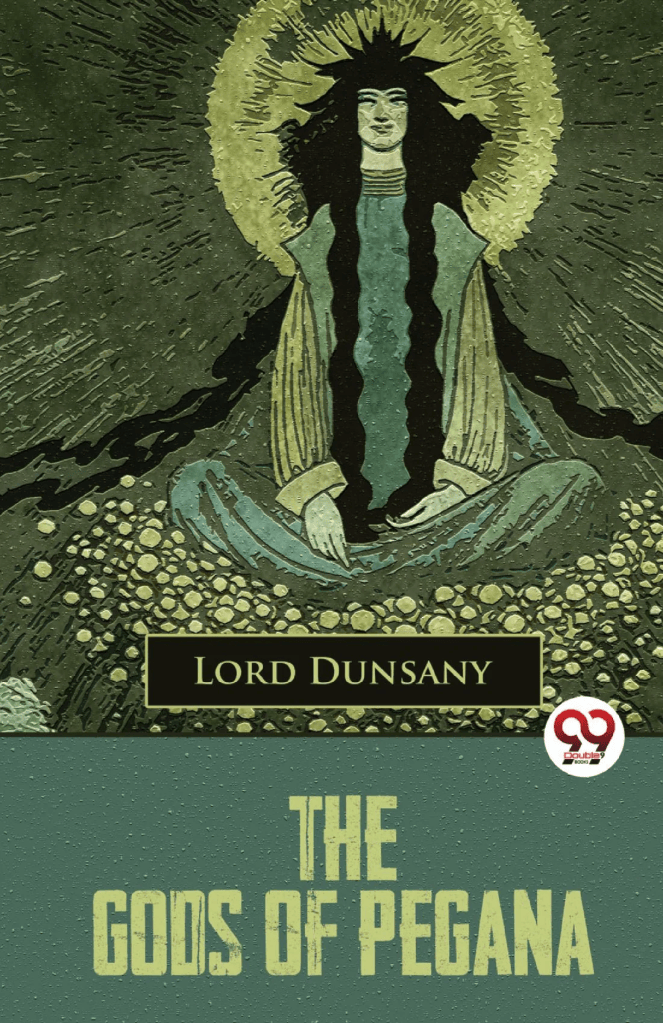
In the Style of Lord Dunsany
The Gods of Pegana releases in 1975, and pioneers the tradition of mythopoeia – the act of artficial mythmaking. A good place to start!
In the days when the Worlds were young and the mortal races first stirred from the long sleep of beasts into the waking dream of sapience, they possessed the fire of life that burns within the chest, yet knew not the burning fire that leaps and dances against the Night. And the Night, who is older than the gods, came upon them cruel and cold. Theirs was a bitter existence.
The gods lifted Their voices, each according to Their turn, to solve this issue. Sparkling stones were housed across the sea of the Night, spears of fire flung down through vaporous clouds, vermin and fungus lit strange and pale, until finally, a fire was harnessed. “This is our gift,” so They spoke, “that you may keep the Night at bay and make for yourselves homes and hearths and places of comfort.”
Then the gods withdrew beyond the Sea of All Sediments, well-pleased, deeming that They had brought succor to their children.
But when They turned their eyes again upon the firmament, They beheld the world wrapped in smoke and heard the sound of weeping. The mortals had taken the holy fire and built with it great walls to shut out their brothers, and had forged in its flames the engines of war, and had turned its light upon the faces of their neighbors with greed and envy. The gift of the hearth had become war, the flame beneath the pot had become war, the light that led the way had become war.
Then were the gods sick with sorrow, and many turned Their faces away.
And Gob, who is small and spiteful, said: “I told them. I did not tell them. But I told them.”
And Essens, whose eyes are sealed, said: “I see nothing. I have always seen nothing. This is why I am wise.”
And Gau, who is a wind, howled: “The smoke! The smoke! It smells of them!”
And They drew across the World a Veil, that mortals might no longer see Them. And the Veil hangs yet between the Worlds, constructed from the smoke of burning homes.
In time, the gods ceased Their wanderings near the Veil. They grew weary of watching, or They found other heavenly labors, or They slept the long sleep. Only the Pantheon remained, the four who would not forsake Their making, Their vigil kept at the Veil’s thinnest boundary, who yet hold a kinship with the mortal races.
Of these Four, Morrowyn was most curious concerning the hearts of the people. She pressed close against the Veil, and through its shimmering saw past the wars that had so embittered Her kind.
She perceived this: that the races of earth need no commandment from heaven to do great cruelty, for theirs is a deep well, and both sweet water and bitter rise from it. Yet She perceived also that within that well lie tender secrets: the longing for an enduring peace, the love of hearth and home, the fierce hope that blossoms amidst ruin.
And She cried aloud, and Her cry was wrensong and salmonbreath, so unused was Her voice: “Aw’chichi aw’chichi aw’chichi!”
Then Morrowyn took upon herself the form of a wanderer. In her left hand she bore a sword whose blade was wrapped in the flames of war, and in her right a torch lit with the flames of home. She rode upon a elk that was Her steed as it was Her Will – Her Will to travel, and to learn about the mortals all had abandnoed. Morrowyn would journey far and wide through the lands of mortals, seeking the hearts of Her subjects, Her eyes a beacon to a future when the men would turn from war to stewardship of the earth once more.
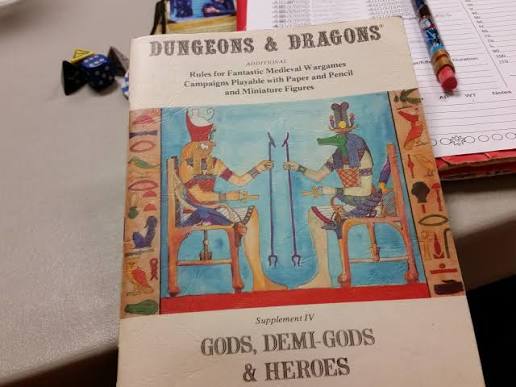
In the Style of Gods, Demi-Gods, & Heroes
Supplement IV for OD&D, Gods, Demi-Gods, & Heroes releases in 1976. It provides stat blocks for the gods, and is surely a suitable template for us to present our own gods to our players.
MORROWYN ~ GOD OF HOME AND HEARTH
Armor Class: -1 (Descending AC) or 20 (Ascending AC)
Movement: 90′ (30′) on foot/240′ (80′) elk
Hit Points: 200
Fighter Ability: 18th Level
Psionic Ability: Class 6 – cannot use psionics but invulnlerable to all psionic attacks
Morrowyn is a straw-haired, antler-adorned lady riding atop a grey elk preternaturally desaturated of all color. She always hits with at least one of her two weapons, the burning sword or the torch, every combat turn. She can cast shafts of light from her hands that vaporize all undead within 150′ of her. Her plus 3 burning sword hits for 3d10 damage and plus 3 torch hits for 2d12 damage. Both disrupt all magical effects on contact. Any ally illuminated by a light Morrowyn has lit will make their saving throw all of the time whilst illuminated. She also shapechanges.
In the Style of a Gazetteer
While the first in the GAZ series, GAZ1: The Grand Duchy of Karameikos was published in 1987 and has no mention of the gods in it, the gazetteer style of presenting information has been a mainstay of both TSR and WotC ever since.
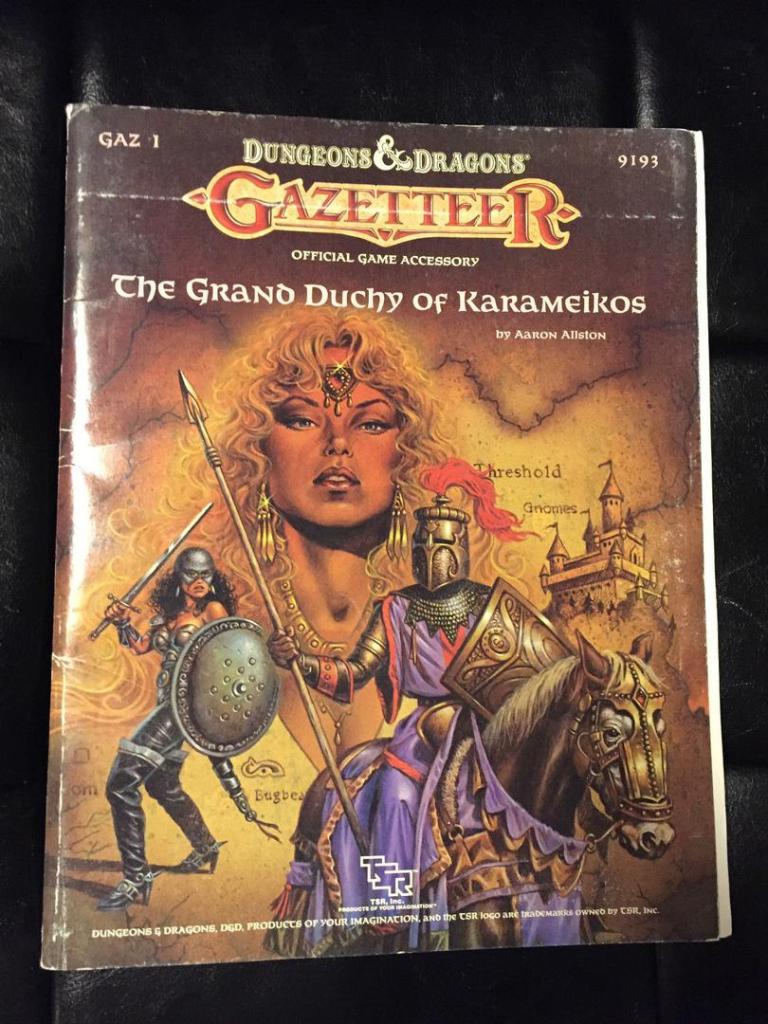
In this case, I borrow some of the specific gazetteer entry headers from the great sourcebook on gods, The Book of the Righteous (link is to a review). Since a gazetteer-like style is essentially just you choosing headers and then filling in information, you can borrow your structure from pretty much any such project, whether it be from the original Gazetteers, some 3rd-party product (I highly recommend Book of the Righteous and Petty Gods, or even from Wikipedia.
ASSOCIATIONS
Morrowyn is the goddess of the hearth, the home, housewives, servants, peasants, and small folk of all variety. She is associated with comfort, contentedness, the warm happiness of a good life. However, especially in Northern climes, she is also associated with the fierce protectiveness of a parent guarding a child, of the strength of community, and of fire standing against the night.
Among animals, domesticated dogs, wrens, and salmon are associated with her, and blink dogs in particular may sometimes speak to priests with Her voice.
SECRETS
While Morrowyn is not a goddess of women in particular, common women without dowries seeking a better life, battered women seeking shelter, as well as wives who have killed their husbands for a variety of reasons and seek escape from justice, all are known to pray for her, and her faith is known to be a refuge for all such faithful.
SERVANTS
Morrowyn is served by certain elder Hags who have been visited by her and blessed by her. Called Crones, these immortal formerly-Hags may appear to women in the midst of difficult labors, or light torches to lead the way for the faithful when they would otherwise be lost to snowstorms. Crones speak with Morrowyn’s voice in the dreams of the faithful, and act as a network for her in times when she wishes to have a more direct impact upon the world.
CHURCH DESCRIPTION
The hearths of Morrowyn, as her temples are known, are not only holy spaces, but also communal kitchens. Great soup cauldrons, large stone ovens, and oval eggs serving as heat-concentrating stovetops adorn…
CHURCH STRUCTURE
Morrowyn’s holy order has the most schisms out of any of the Pantheon’s gods, perhaps because she is one of the most direct at dipping her hand into mortal affairs. In the North, there are the Hearthkeepers, an order more dedicated to fire worship and the extermination of monsters than any aspect of her more gentle domains. In the East, there is the Refracted Order, knights who view the slaying of vampires on the Other Side of the Looking Glass as their greatest divine calling…
DOCTRINE
Morrowyn has a simple doctrine of service and humility, requiring nothing more of her followers traditionally. Yet by reasaon of the many schisms which have arisen among her faithful, each order maintains its own tenets, some of which stand in direct contradiction to one another. For instance…
COMMON PRAYERS
“Kindled lady, shine on us
For in thy name we break our bread..
Bread, no, cannot rise without warmth,
Nor can man do much the same,
O Kindled lady, shine on us
And know we do honor thy name.”
“Brightest heart, brightest mind…”
TITLES
The faithful of Morrowyn refer to each other as brothers and sisters, and temples typically have a matriarch. There is a supreme matriarch who oversees all hearths, even across schisms, but within the order there are more localized titles for leaders, such as…
In the Style of a Anti-Canon
Jumping ahead quite a bit, anti-canon worldbuilding has been a staple of a lot of OSR blogs before it was coined as a term, but the terminology was officially canonized by Luka Rejec, author of Ultraviolet Grasslands and the Black City. Afterwars, the term exploded, with Luka Rejec, Ty Pitre of Mindstorm Press, Nova of Idle Cartulary, and Prismatic Wasteland all making use of it as a way of fleshing out a world.
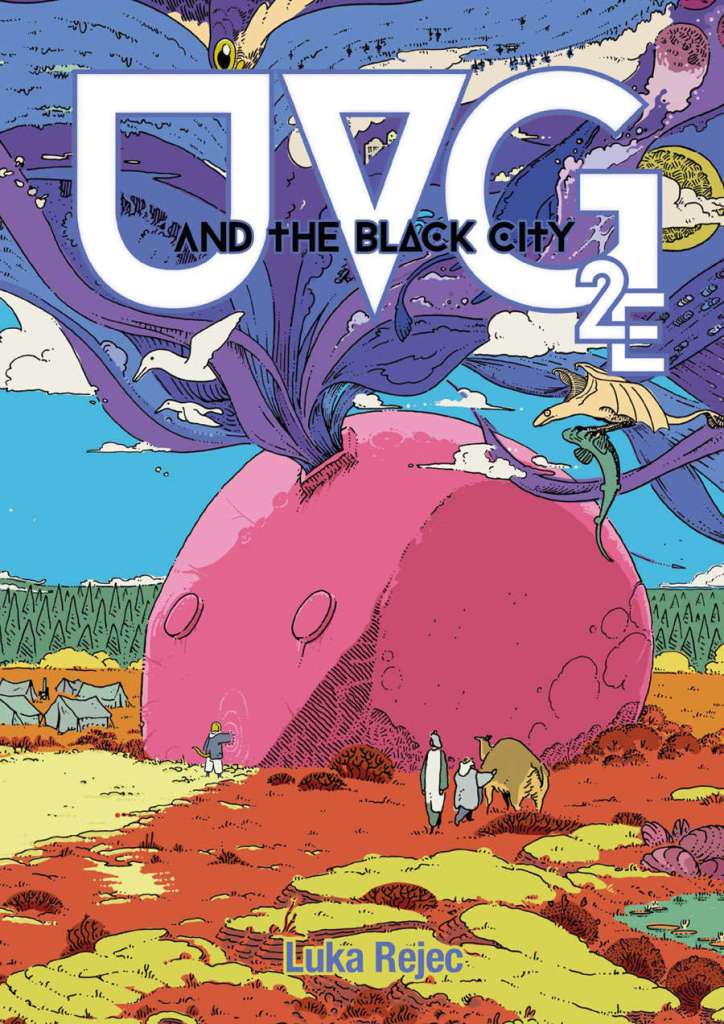
The quickest blurb that explains what anti-canon is, is this:
[…] games that revolve around the dynamic interaction of players and referees and texts, and where the world is a unique and ephemeral creation that appears for a moment in the collective imagination of the group, before dissipating again, falling to the subconscious to fertilize new ideas, new worlds, new stories […]
There are many ways to do this – I think anti-canon writing is a bit more difficult, but one of the simplest ways is to use rumor tables wherein the rumors are internally inconsistent. Multiple entries contradict one another, and this is on purpose – it is to allow the referee, in the middle of running a game, to develop the canon different ways as they see fit, from the initial seeded ideas in the rumor table, without needing to worry if it is “in line” with a core, centrally true lore.
Imagine, for instance, the following table, but without any of the previous forms of presentation. It references some of the previous lore (and you, reader, will understand it perhaps in that context), but if it were standalone, it would introduce intrigue without locking in the referee of any campaign to the lore above. Indeed, the referee could do much to bend it and change it, campaign-to-campaign. Which would be much the point of an anti-canon presentation.
MORROWYN…(1d10)
- Possesses an elk that is no beast at all. Once, the elk was a mortal king, one of the first to take gifts from the gods and to use them for war. Morrowyn transformed the king into an immortal elk as penance for his corruption of divine gifts. The flames that dance along the elk’s antlers will one day go out, and the king will be able to rest in peace.
- Carries a sword that has never been drawn. She is too committed to the idea of peace to draw it. Rather, it is a somber reminder of the violence she is pushing back against, ever so gently, until the day the races of the Dawn State can live in peace.
- Kills all who recognize her with fire and brimstone. Let us not forget that for all that she is the goddess of home and hearth, it is only with great violence that we can defend our families, and Morrowyn’s family is traumatized many times over by the transgressions of mortals. The goddess is curious about our lives, yes, but that does not mean she welcomes attention into her business, or worse, the business of other gods. If you suspect Morrowyn has taken the form of a wandering in your village, treat her with respect and send her on her way. Do not ask too many questions.
- Weeps over the Veil, begging the other gods outside the Pantheon to return. As the Goddess of Light, whenever she weeps, clouds cover the sun and cause it to rain.
- Created the world with her cry, “Aw’chichi aw’chichi aw’chichi.” This holy sound realized the world. Before it was a nebulous shape, a sense, a memory, an imagined thing. Her cry resonated through what the gods had dreamed up, and gave it shape, crystalized it into something real and precious.
- Embodies all the gods of the Pantheon, who are One with her. Four gods in one, but with many faces.
- Created the schism in her order. Who else could? It is not upon mortals to cause cracks in their faith, so Morrowyn’s doctrine must be intentionally vague. The Goddess wants her followers to argue, for in argument there is engagement, and in engagement lies true faith. The fact that true faith divides households or causes communities to grow bitter is a tragic side effect, but let it also be said that the families we find are the true families that Morrowyn holds up as valuable, as the hearths we must protect.
- Was horribly scarred by Gob the Spiteful, one of the Leaving Gods, who is not part of our Pantheon anymore, but who forever cursed her with a gash across her face, that you can sometimes see in portraiture or in sculptures of her. That gash across her face is reflected in her clergy and her faithful as well – why does she have so many schisms in her priesthood and among her followers? It was because Gob’s physical injury inflicted upon her is a psychic injury reverberating throughout her existence.
- Can bring the dead back to life, and indeed is the only one of the Pantheon with that power. Those who worship the other gods, but who are not faithful to her, may find that their attempts at revival, even if they are accomplished clerics, will inevitably fail.
- Is a secret Goddess of Theft and Trickery. There are two fires she wields, but in the original myth, the gods only gave mortals one fire – the fire of life, the fire that defends against the dark, and the fire that mortals turned to war. The second fire that Morrowyn brings, the guiding light that will take mortals to an everlasting peace, is one she stole from the Leaving Gods. But you cannot build something good out of something corrupted, and so the everlasting peace she hopes for can never come to be, built as it is upon original sin. Of war, for us. Of theft, for her.


Leave a Reply